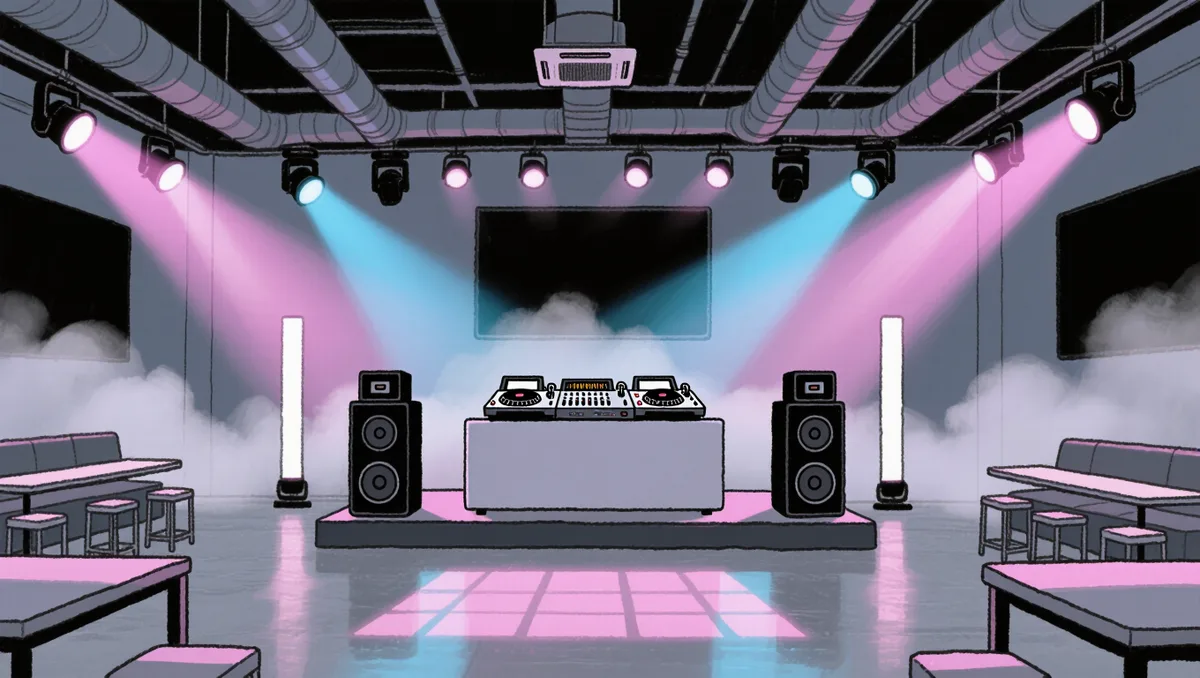
A track at 126 BPM ends. The next one sits at 174. That gap — drum and bass tempo after house, or techno into garage — is where genre switching lives or dies. Done well, the floor never notices the seam. Done badly, it clears in about thirty seconds.
The good news: the jump is a craft problem, not a mystery. DJs move between tempos using a handful of repeatable techniques — double-time blends, breakdown resets, bridge tracks and, sometimes, the hard cut. Each has a moment where it is the right call, and each has a moment where it will cost you the room.
Why tempo gaps break a mix
Beatmatching only works when two tracks run close to the same speed. A 3% nudge is invisible. A 40% gap is not. You cannot pitch a 124 BPM house record up to 174 without it sounding like a chipmunk, and you cannot drag a drum and bass tune down to 124 without it turning to sludge.
So the tempo change has to happen somewhere the ear accepts it. The floor forgives a speed jump during a breakdown, an intro, or a moment with no steady kick. It punishes one mid-groove, when bodies have locked onto the beat. That single principle explains nearly every technique below: change tempo when the beat disappears, or make the old beat and the new beat coexist briefly so the ear can bridge them itself.
If you are still building the core skill underneath all this, our guide to how to beatmatch by ear covers the foundation, and harmonic mixing and the Camelot wheel explains why some key clashes sting harder than others when you blend across styles.
What is a double-time blend?
The double-time blend is the workhorse of genre switching. The maths is simple: 174 is almost exactly one and a half times 116, and almost exactly double 87. So a hip-hop track at 87 BPM mixes against drum and bass at 174, because the half-speed pattern of the fast track lines up with the slow one. The same trick links 128 BPM techno with 64 BPM half-time intros, or 140 dubstep with 70 BPM hip-hop.
In practice: beatmatch the incoming fast track against the outgoing slow one, treating the fast track's bar as two bars of the slow tempo. Blend during the slow track's breakdown or outro, where its kick has stepped back. The crowd hears the new energy arrive inside a rhythm they already trust. Then the old track drops out and the new tempo is simply what's playing.
This works best going up in energy. Going down — from drum and bass into a slow groove — the same blend can feel like the room lost air pressure. Save the descent for a natural lull, not a peak.
How do breakdown resets work?
Every dance genre has a moment where the drums stop: the breakdown. That silence is a reset button. Kill the fader at the end of a phrase, let the outgoing track's breakdown breathe, then drop the new genre's intro straight in with no blend at all. The crowd got a natural pause; the new tempo arrives with a fresh start.
The craft is in the timing. Cut on the phrase, not against it — a four-bar or eight-bar boundary, never mid-loop. And match the mood across the cut. A euphoric trance breakdown flowing into a moody techno intro jars even when the tempo maths is clean. Energy shape matters more than key here, though checking the key never hurts.
Breakdown resets suit big tempo jumps where no double-time relationship exists — say, 145 trance into 126 progressive. When the numbers don't help you, the silence will.
What are bridge tracks?
A bridge track is a tune that belongs to both worlds. Half-time intros, tempo-flexible edits, and genre-mashing records exist precisely to solve this problem. A house track with a drum and bass remix in your crate gives you a legal exit: play the original, then the remix, and the tempo change happens inside one artist's own material. The crowd accepts it because the record announces it.
Build a small bridge section in your library deliberately: a few tracks around 100 BPM, a few half-time cuts, a couple of edits that sit between your main genres. You will not need them every set. When you need one, nothing else does the job.
Bridge tracks also buy you time. Instead of one dramatic jump, you make two small ones — 126 to 100, then 100 to 174 — each of which the floor absorbs without complaint. Think of it as switchbacks down a steep hill rather than a leap.
When does a hard cut beat a clever transition?
Sometimes the honest move is no blend at all. A hard cut — full stop, one beat of silence, new track — reads as a statement. Peak-hour crowds often read a fussy, over-long transition as nerves. Confidence sells the cut.
Three situations favour it. First, when the new genre is the reason people showed up: the drum and bass headliner does not need to tiptoe in from tech house. Second, when the room's energy has already peaked and no blend will hide the gear change. Third, when the outgoing track has a clean, decisive ending that does the work for you.
What kills a hard cut is hesitation. Cut late, cut early, or fade slowly and the seam shows. Commit, and the room commits with you. This is also where reading the room beats any formula — the same cut that ignites a 2 a.m. main floor can puzzle a 11 p.m. bar crowd still finding its feet.
Practical steps: building your genre-switching kit
Our analysis of how working DJs handle this comes down to preparation, not heroics mid-set:
- Map your tempos. Know which pairs in your library have a double-time or half-time relationship. Write them down once; you will remember them forever.
- Tag bridge tracks. Keep a shortlist of half-time intros and cross-genre edits where you can reach them fast.
- Plan the exit, not the entrance. The hardest part of any tempo change is leaving the old track cleanly. Know which bar you will step off.
- Rehearse the cut. A hard cut is a skill like any other. Practice the silence until it feels intentional, not accidental.
- Match energy, not just tempo. A genre switch lands when the emotional arc continues. Check the mood before you check the maths.
Where the switch sits in your overall arc matters too. A mid-set genre change is a different animal from the one that hands over to the headliner — our guide to how DJs build a set from opening to peak covers that larger shape, and the art of the warm-up set explains why early slots reward restraint over dramatic switches. For related coverage, see How DJs Build a Set: From Opening to Peak.
What this means for your next set
Genre switching is not about showing range for its own sake. The floor does not care how many styles you can play. It cares whether the night keeps moving. Pick the technique the moment demands: double-time blends when the maths cooperates, breakdown resets when it doesn't, bridge tracks for long journeys, and the hard cut when conviction is the whole argument. Get the exit right, commit to the entrance, and a 50-BPM jump becomes just another phrase in the night.
The gear rarely matters here — the same moves work on a club CDJ setup or a bedroom controller. What matters is knowing your library well enough that the right option is already loaded. We covered a connected angle in DJ Controller vs CDJ: Which Setup Should You Buy?.