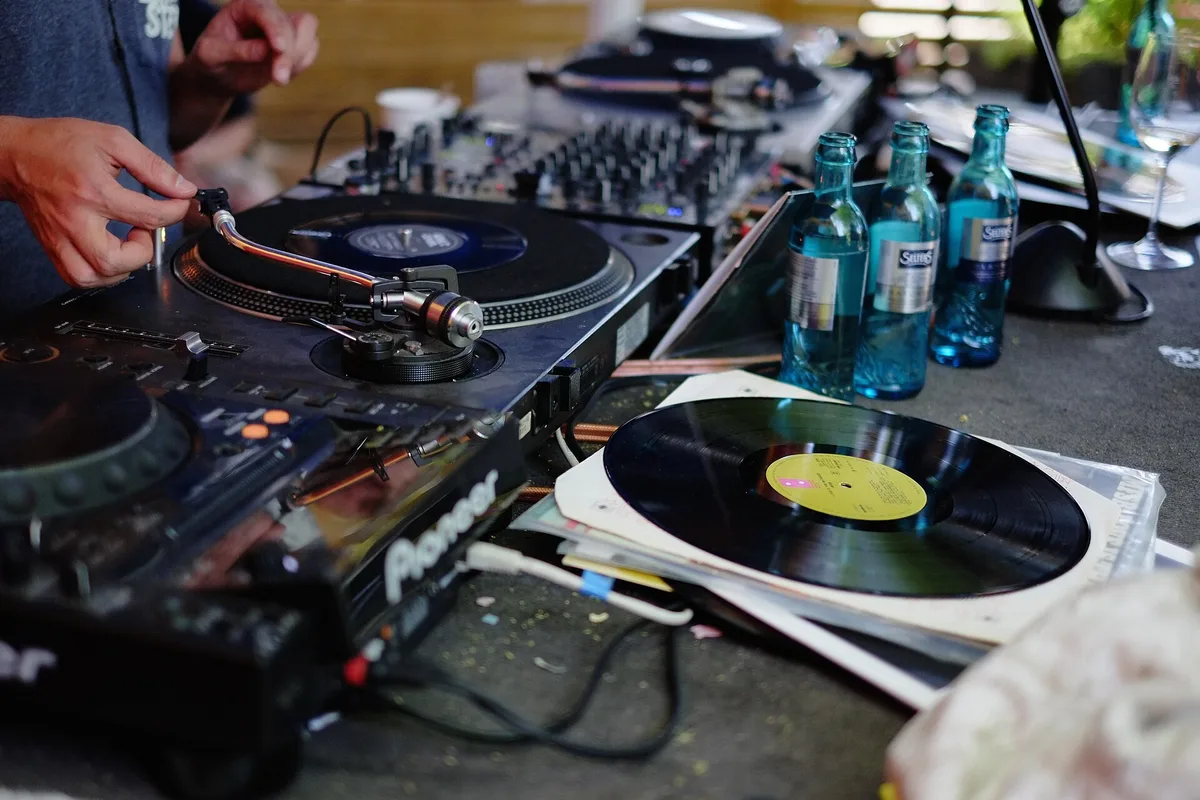
The record slips out of the sleeve. The needle drops. There is a hiss, a thump of the run-in groove, and then the kick arrives with no waveform on a screen to tell you when it will. That small delay is why a stubborn group of DJs still haul heavy bags of vinyl to gigs that a single USB stick could cover.
A vinyl DJ setup is a turntable-based rig where the music lives on physical records rather than files. The format itself is simple: a vinyl record is a phonograph record pressed from polyvinyl chloride, as Wikipedia notes in its entry on the term. What makes the setup demanding is everything around that disc — the weight, the cost, the two-track limit, and the skill it forces you to build.
So why bother? Because the constraints change how you play. Vinyl rewards deep preparation, sharp ears and a smaller, better-chosen selection. This guide explains what the setup involves, what it costs you, what it teaches, and when it makes sense in a club world that has mostly moved on. We covered a connected angle in How Club Sound Systems Work: A DJ's Guide.
What exactly is a vinyl DJ setup?
A standard rig has two turntables, a mixer between them, and a record collection. Each turntable holds one record with roughly a dozen or so tracks on each side, depending on the music and the pressing. That is the whole library. No search bar, no playlists, no crate of ten thousand files.
Many working rigs add a digital layer. A digital vinyl system, or DVS, lets special control records drive music stored on a laptop, so you keep the feel of vinyl while playing files. Our explainer on how digital vinyl systems work covers that hybrid path in detail. Purists in the turntablist tradition tend to draw a line here: control vinyl is a tool, real wax is the format.
The mixer matters too. If you are new to that hardware, start with our beginner's guide to reading a DJ mixer, because on vinyl every transition runs through it. There is no sync button to lean on.
Why do some DJs still swear by wax?
The honest answer starts with sound and touch, not nostalgia. A record is an analog signal cut into a groove. The stylus reads it directly. Many DJs describe the playback as warmer or fuller, and while that debate can get tribal, the physical interaction is not in dispute: you cue by feel, you nudge the platter with your fingertips, and you hear the pitch bend under your hand.
The second answer is discipline. With two decks and a finite crate, you cannot hide behind volume. Every track in the bag earned its place. That pressure builds skills fast, especially beatmatching by ear, which remains the core craft whether you end up on wax or files.
The third answer is selection. Vinyl forces a kind of curation that a hard drive never will. You dig, you listen, you commit money and shelf space, and the result is a set that sounds like one person's taste rather than a folder. Turntablists — the DJs who treat the turntable as an instrument, scratching and juggling beats — argue this connection is the whole point. The record responds. A file does not.
What does it cost to play records?
Money first. New pressings are not cheap. A browse of the vinyl.com record store shows new titles listed in the roughly twenty-to-thirty dollar range, and that is per record, for music you may play once in a set. Build a functional club bag of even fifty records and the spend adds up quickly, before you count sleeves, flight cases and cartridges.
Then there is the physical toll. Records warp in a hot car. They crack when dropped. Sleeves split. A hard drive survives a fall; a crate does not. And weight is real: a bag of vinyl is the heaviest thing most DJs carry, which is why the phrase "carrying crates" survived the digital era as shorthand for doing things the hard way.
Availability is the quiet cost. Plenty of electronic music exists only as a digital release. If a track never got pressed, a vinyl-only DJ simply cannot play it. That shapes repertoire toward labels and eras with strong physical output, which some players see as a feature, not a bug.
How do you actually DJ on vinyl?
The process is older than the club industry's obsession with specs, and it has not changed much.
- Dig and select. Build a small, deliberate crate for the gig. Know every record in the bag, including its tempo and where its energy sits. Our guide to how DJs build a set applies here with one difference: your options are the records you brought.
- Cue by ear. Drop the needle near the start, find the first downbeat, and listen on headphones. You nudge the record or the platter until the beats line up. No grid, no waveforms.
- Ride the pitch. Records drift. Small adjustments with your hand on the label or the edge of the platter keep two tracks locked. This is the skill that separates vinyl DJs, and it transfers to every other format.
- Mix and move. Blend with the mixer's EQ and faders, then release the record. Back-cue it, sleeve it, and reach for the next one. The workflow is slower, and the pace of the set follows.
Tempo changes demand extra care, since you are matching speeds by hand rather than letting software do it. Our piece on switching genres mid-set covers the musical logic, which matters even more when the machinery will not forgive a lazy transition. For related coverage, see Switching Genres Mid-Set: How DJs Move Between BPMs Without Losing the Floor.
Is vinyl still practical for club gigs?
It depends entirely on the room. Some clubs and dedicated nights keep turntables installed and actively book vinyl-first DJs. Many more venues have moved to CDJs and controllers as the house standard, because they are compact, reliable and file-based. If you show up with a crate, call ahead and confirm the booth has working turntables and ground connections for your cartridges. Never assume.
Practicality also depends on your role. A warm-up slot with a slow build suits a limited crate well; our guide to the art of the warm-up set explains why restraint reads as skill in that slot. A peak-time festival set with rapid genre jumps is a harder ask on two decks and forty records.
What this means for a working DJ: vinyl is a craft investment, not a replacement for digital. Most professionals who play wax also play files, and choose the format per gig. The skills overlap completely. The library does not.
Where the crate goes from here
The evidence points one way: vinyl survives because of what it demands, not despite it. It is expensive, heavy and finite, and those limits produce DJs who listen harder, select sharper and mix by hand. The format has also become a visible part of club culture again, with new pressings on shop shelves and dedicated vinyl nights in most cities with a real scene.
What remains unknown is how long new electronic releases keep getting pressed at a pace that supports vinyl-only careers, since that depends on label economics no guide can settle. What is settled is the craft argument the turntablists make: if you can play records, you can play anything. The reverse is not true. And that, more than sound quality debates or romance, is why some DJs still carry crates everywhere.