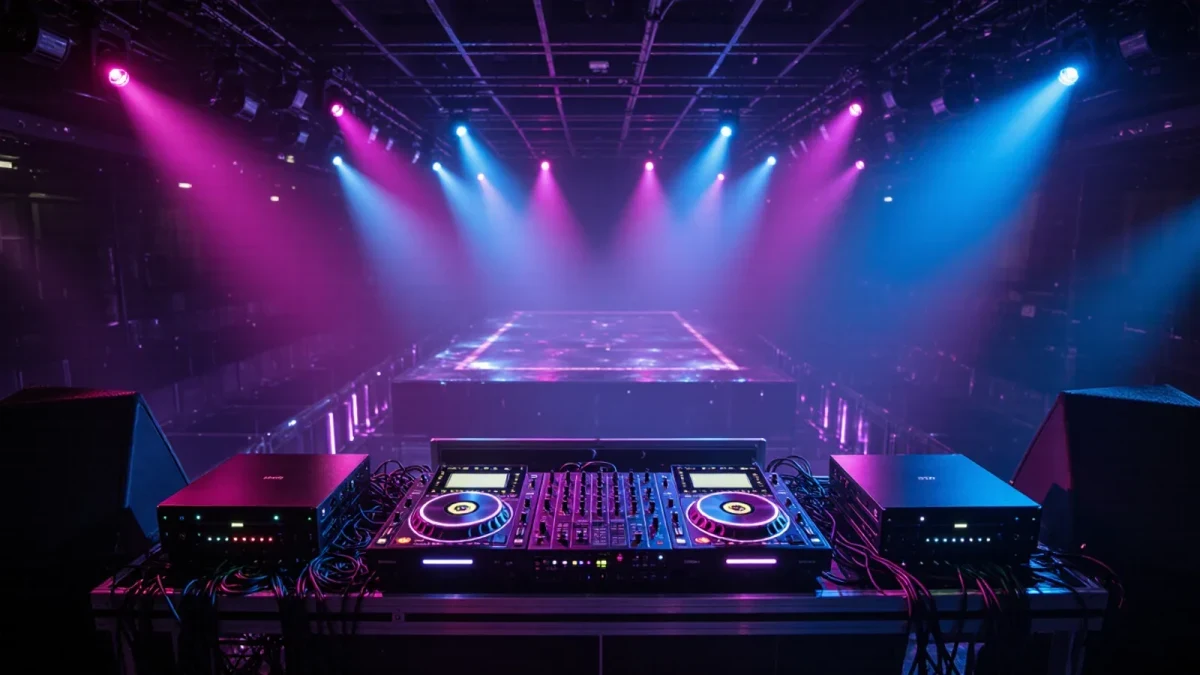
A DJ set is built as an energy arc: you open below the room's mood, climb through the middle with planned peaks and controlled rests, and land the closing track with intent. Structure supplies roughly half of that — the other half is reading the floor in real time and choosing which prepared card to play. Understand the arc's four phases and the decision rules inside them, and your USB stick stops being a folder of songs and becomes a set.
What follows is craft, not doctrine — every scene from techno to amapiano bends the template to its own tempo culture.
What does an opening phase actually do?
The opener's job is to set a table, not cook the meal. Rooms fill slowly, and a floor that arrives to peak-time bangers at eleven has nowhere to go but down. Strong openers start five to ten BPM under their target tempo, keep kicks sparse, and let conversation survive — early guests are deciding whether to stay, and music that bulldozes that decision loses them.
Practically, the opening pocket runs on groove rather than drops: dub versions, tool tracks, deep cuts with long blends. Track density matters as much as tempo — a busy vocal anthem at low BPM still reads as loud. The classic move is holding one or two unmistakable records in reserve, the instant floor-fillers you deploy only when the room is ready to catch them.
Length matters too. A one-hour warm-up slot has a tighter arc than a three-hour headline set; knowing your slot before you build the folder is half the preparation.
How does a set climb to the peak?
The climb is a staircase, not a ramp. Working DJs raise energy two ways: tempo creep — half a BPM to a BPM every few tracks, unnoticed in the blur — and texture, swapping dubbier elements for fuller arrangements, tighter hats, bigger stabs. Each step should feel like the natural next thing; each step should also be reversible.
Reversibility is the professional detail. A set that only escalates becomes exhausting by hour two, so strong builders plant breathers — a melodic passage, a beatless interlude, a classic reset — one or two tracks before the next push. The floor gets thirty seconds of oxygen and then the next riser lands harder for it.
A useful planning tool is energy labelling: rate every track in the folder from one to ten for dancefloor force, and sketch the set as a number sequence — 3-3-4-4-5-4-6-6-7 — rather than a song list. You will never play the exact sequence, but the shape teaches you what the folder is missing, which is usually a 5 and an 8, not another 10.
How do DJs read the dancefloor?
Reading is three channels of information, checked constantly. Faces: are people locked in, chatting politely or drifting to the bar. Feet: a floor that stops shuffling during a track has told you something regardless of your affection for the record. Density: who arrived, who left, who moved closer to the booth — the last one usually means the last two selections worked.
Response time is the craft. A wrong record does not need rescuing in eight bars; play one corrective selection — same family, flatter energy — and watch again. Two misfires in a row means the read was wrong, not the crowd: drop a gear, rebuild trust with something proven, and climb again.
The best readers also distinguish their taste from the floor's. A record you love that reliably empties a room is a bedroom record; keeping it in rotation for your own satisfaction is a choice, and an expensive one at a club that books you once.
How do transitions and keys shape the arc?
Transitions are where arc plans survive contact with the booth. Blending on phrase — eight or sixteen bars, swapping elements at musical boundaries — keeps the arc smooth; hard cuts and rewinds are arc tools too, used for punctuation: a stop-time drop resets attention, a vocal snipped over a new beat signals a chapter change.
Key relationships grease the same wheels. Harmonically compatible mixes let a climb feel effortless, while a deliberate key clash on a big transition can read as drama — used once, deliberately, it is a moment; used by accident, it is a mistake the whole floor hears. Energy management and key management work best when they are the same decision.
Genre jumps obey the same law. A house set that wants to reach trance's euphoria needs bridge records — melodies creeping in, hats tightening — not a teleport. The crowd follows stairs; it resents trapdoors.
What about the closing track?
Closings are authored. The best final tracks do one of three things: land the emotional payoff the whole arc promised — the anthem you withheld for two hours; exhale, a warm classic that says walk home slowly; or wink, a curveball that becomes the story of the night. Choose before the set and protect the choice; nothing sags like a DJ visibly hunting for an exit.
Then comes the handshake with whoever follows. In clubs, ending on a clean, mixable groove with a clear BPM noted for the next DJ is basic booth etiquette — the arc you finish becomes the floor they inherit.
And log the set afterwards. Playlist exports, notes on what worked: the cheapest education in DJing is your own record of rooms, hours and responses — a private dataset no sync button will ever hand you.
How much should you plan versus improvise?
The working ratio most pros describe: prepare everything, decide nothing. Folders organised by energy and key, breathers stocked, closers chosen — then let the room pick. A rigid script breaks the first time the floor disagrees; no preparation leaves you hunting on bent knees at 1 a.m. The arc is the plan; the tracks are improvisation.
That balance is also what makes sets repeatable as craft. Build the folder, trust the arc, read the floor, protect the closer — the rest is tempo.