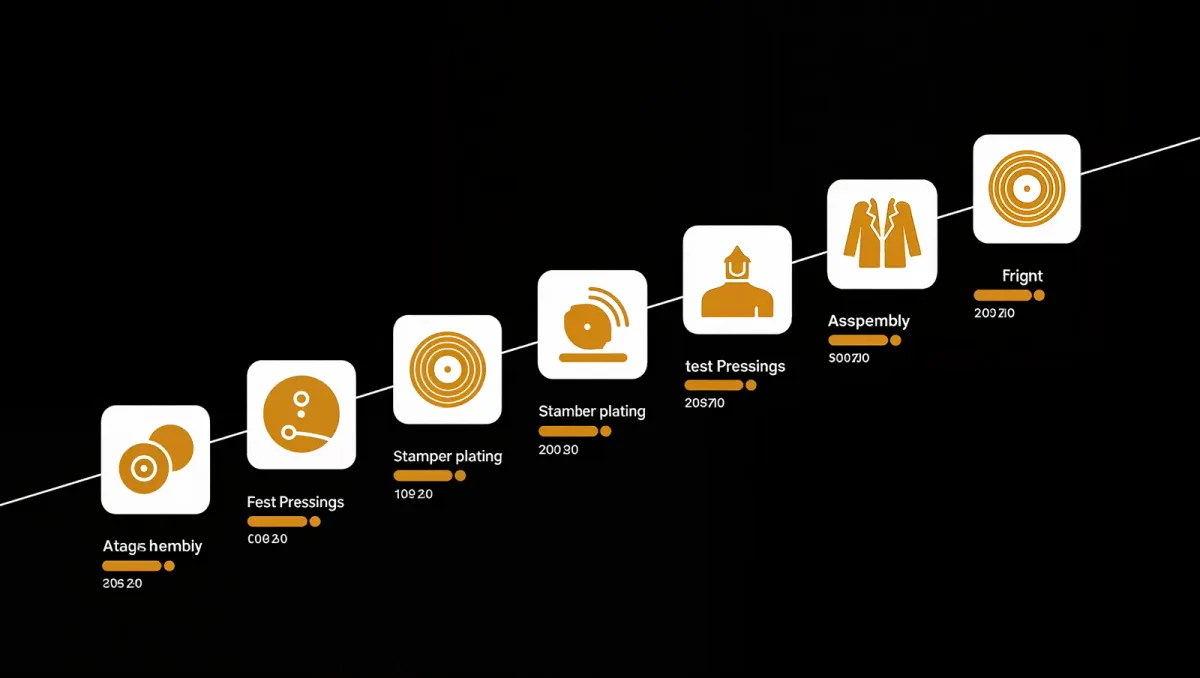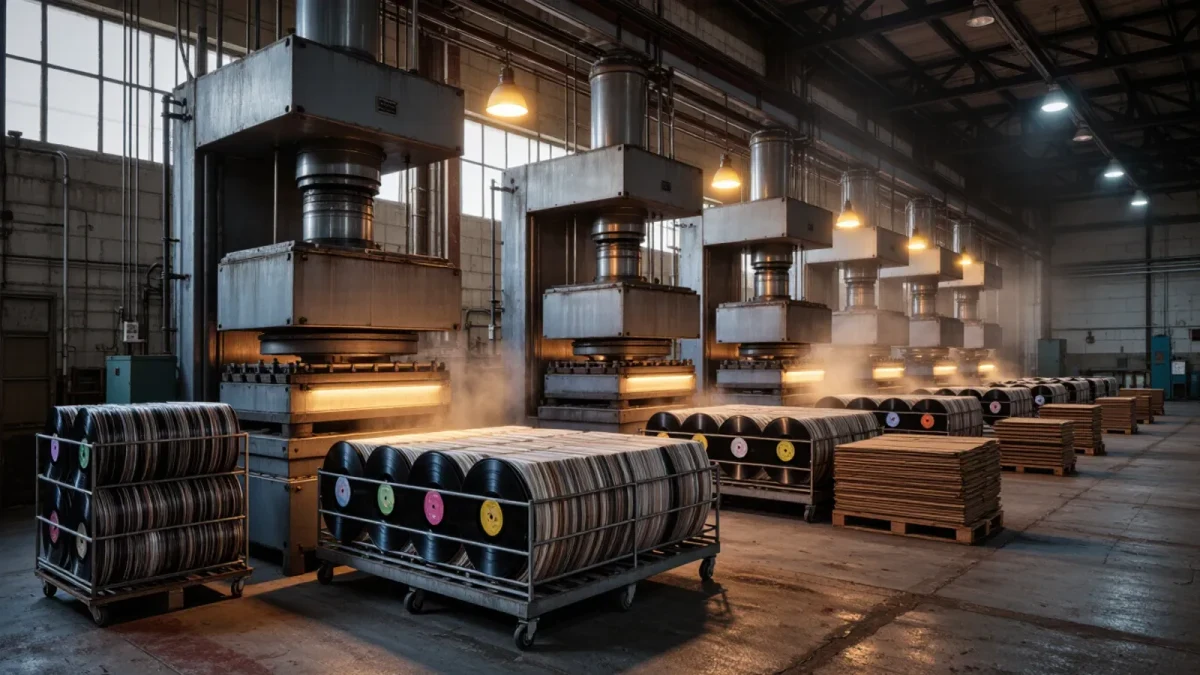
Global vinyl pressing capacity is concentrated in a few dozen major plants, and lead times for new orders still run to months — commonly nine to twelve months by industry estimates as of 2025 — because demand for vinyl has grown for nearly two decades while pressing capacity, equipment and trained staff have not kept pace. For electronic labels, the queue is now a planning constraint as basic as the release date itself.
Mega Dance publishes information, not business advice; plant quotes vary and every order is its own negotiation.
Why is pressing capacity so tight?
Three bottlenecks stack. First, the machines: new hydraulic presses are built to order by a small number of manufacturers, and each costs as much as a house before installation. Second, the people: press operation is skilled manual work, and the workforce that retired with the CD era was never fully replaced. Third, the demand mix: vinyl's comeback — nineteen consecutive years of growth in the US market — is led by major-label reissues and superstar releases that book plant capacity in enormous blocks, squeezing small labels into the gaps. Industry analyses as of 2025 count roughly fifty major pressing plants worldwide, a strikingly thin layer of infrastructure for a format that now sells tens of millions of units a year in the US alone.
How bad are the lead times?
Dramatically better than the crisis peak, still far from comfortable. Before 2020, a standard order often came back in weeks. During the pandemic surge, lead times stretched toward a year, with some reports of new albums waiting far longer when superstar releases queued ahead of them. As of 2025, quotes of nine to twelve months for new customers remain routine, while plants reward commitment: clients who reserve capacity in blocks or place standing orders are quoted meaningfully shorter windows. One US plant has publicly advertised roughly twenty weeks for clients locking in reserved capacity — half the wait of a walk-in order, and a perfect summary of the market's structure: the queue is shorter for those who can buy their place in it.
What does this mean for electronic labels?
The release calendar bends around the pressing queue. Common adaptations across the scene:
- Digital-first, vinyl-later releases — the digital date is announced; the physical edition ships whenever the plant delivers, weeks or months after.
- Pre-order-funded pressings — labels open pre-orders before committing to a run, converting the biggest fixed cost into pre-paid demand.
- Smaller runs — 300 copies instead of 500, keeping the catalogue alive while capping exposure.
- Split catalogues — pressing at several plants simultaneously, trading single-plant consistency for schedule certainty.
How much does pressing actually cost?
More than it did, and in more than one currency. The cash price of a standard 12-inch run of 300 has moved into the range of roughly 1,500 to 2,500 euros depending on plant, packaging and coloured vinyl options. The hidden price is schedule risk: a label announcing a release before records exist is betting on a plant estimate, and estimates slip. Coloured vinyl, gatefold sleeves and picture discs each add cost and, sometimes, queue time. The economics still work for labels with direct-to-fan shops, where margins survive; they hurt most at the middle of the market, where a label neither has superstar volume nor a fanbase willing to pay premium prices.
Is anyone adding capacity?
Yes, steadily, though not fast enough to erase the queue. Existing plants have added presses, and new entrants — including artist- and label-owned operations — have opened on several continents, often targeting exactly the small-run market the giants underserve. Some plants have built on-site power and PVC supply arrangements to escape the energy and material shocks that disrupted 2022-2024. But the industry's own projections as of 2025 see pressing-services demand growing faster than capacity through the decade, which means the nine-to-twelve-month world is not a temporary distortion; it is the operating environment. Labels that plan around it — booking capacity a year ahead, pre-selling runs, keeping digital and physical dates separate — treat the queue as fixed cost of doing business.
How do labels choose a pressing plant?
By weighing three things the quotes never quite state plainly. Consistency: a plant's pressing quality varies with its quality control, and a label's customers blame the label for off-centre records, not the plant. Schedule honesty: some plants quote optimistically and slip routinely; others quote long and deliver on the day, and experienced label managers pay for the second kind. And communication: a plant that answers email during a delay is worth more than a cheaper one that goes silent. The scene keeps informal lists of all three, passed between labels the way all practical scene knowledge travels.
Geography still matters too. European plants cluster near the Netherlands and Germany, where the format's industrial base never fully died; pressing in the region your buyers live in shortens the last, most fragile leg — shipping. Some labels split runs between continents for exactly that reason. Others accept the queue at a prestige plant because the plant's name in the run-out code is itself a quality signal collectors have learned to read.
Is there an alternative to pressing at all?
A growing shelf of them. Lathe-cut records — cut one at a time on a lathe rather than pressed from a stamper — suit runs of fifty, at higher unit cost and slightly different sound. Some plants offer short-run pressing with digital sleeving for quantities the big lines will not touch. And the CD, written off a decade ago, quietly persists for small electronic labels as a cheap physical artefact at shows. None of this replaces the pressed 12-inch at scale. But between lathe cuts, short runs and CDs, a small label today can sell a physical object in the same season the music was made — a sentence that was not true at the peak of the queue.
The queue has already changed the artefact. Today's 12-inch is more often pre-ordered, smaller-run and later than its digital self — a collector's object by economic necessity. That is not the crisis headline of the pandemic years. It is the steady state, and the scene has adjusted.