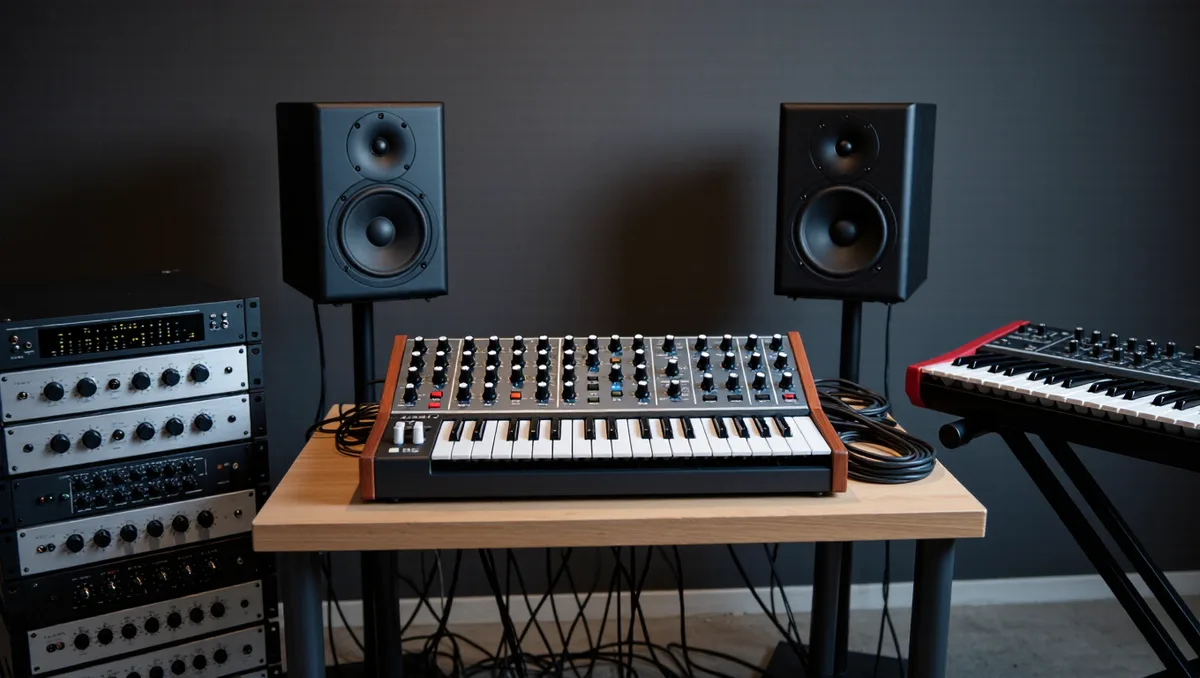
A drum machine is an electronic instrument that plays drum and percussion sounds on its own, following a rhythm pattern the user programs in. It replaced the session drummer with a box you could carry under one arm. That shift remade popular music, and nowhere more than in dance culture: house, techno and their offshoots exist because a handful of these machines sounded wrong in exactly the right way.
The short answer to the question is this. A drum machine stores individual drum sounds — kick, snare, hi-hat, clap, tom — in memory or on synth circuits, and triggers them in a repeating sequence. Program a four-on-the-floor kick, close the hi-hat on the offbeats, and you have the skeleton of a dance record. The most important qualification: the machines that built the scene were commercial failures when new. Their sounds survived because producers bought them cheap secondhand and pushed them past their design limits.
Drums themselves are ancient. As Wikipedia's drum entry notes, they consist of a membrane stretched over a shell and struck by hand or stick, and they are among the world's oldest instruments. A standard drum kit pairs that with cymbals and a snare — the drum with wires held across its head, which give it that sharp buzz. The drum machine took that familiar kit and rebuilt it in circuitry. What follows is the machine-by-machine story of how it happened.
How does a drum machine actually work?
Two technologies matter, and the split between them explains why different machines sound so different. Early units used analogue synthesis: the kick is an oscillator with a pitch that drops fast, the snare a burst of filtered noise, the hi-hat a ring of metallic square waves. Nothing is recorded. The sound is generated live, every time, and it never quite repeats identically.
The second approach is sampling: record a real drum hit, store it in memory, play it back. Sample-based machines sound realistic; analogue ones sound synthetic. Producers learned to love both, often in the same track — a sampled break underneath, an analogue kick and clap on top. Programming is the third piece. You place hits on a grid of steps, usually sixteen per bar, and the machine loops the pattern until you stop it. That grid is why so much electronic music sits at steady, quantised tempos, and why the Electronic Music BPM Cheat Sheet: Every Genre is such a useful map of the family tree.
Why did the TR-808 become the sound of everything?
Roland's TR-808 was built to sit quietly behind a demo, imitating real drums well enough to sketch a song. It did not imitate real drums. Its kick is a long, booming sine thud with no real-world equivalent. Its snare cracks like a snapped twig. Its cowbell is a joke that became a genre fixture. The company sold it for a few years, moved on, and the boxes flooded the secondhand market at prices a broke producer could manage.
Then the underground found them. In Detroit and Chicago, and in the Miami bass scene, producers built entire records around the 808's kick because it was the deepest low end available without a studio. Hip-hop took the same route. The 808 kick is now so embedded in popular music that it functions as a default — the sound you hear in your head when someone says "electronic kick". That is a strange fate for a discontinued demo tool, and it happened because failure made it cheap and cheap made it everywhere.
What made the TR-909 the techno machine?
The 909 is the 808's harder sibling, and the reason techno sounds like techno. Roland designed it as a hybrid: sampled hi-hats and cymbals for realism, analogue kick, snare and claps for punch. Its kick is shorter and drier than the 808's — a thump rather than a boom — and it cuts through a club system instead of drowning it. Its open hi-hat hisses like a pressure valve.
Detroit's first generation of techno producers leaned on the 909 hard, and the machine's character became the genre's character. You can hear the lineage directly today. Hard techno at speed still runs on that punchy kick shape, which is why our What Is Hard Techno? 150 BPM, Explained guide spends time on low-end design. Gabber pushed the same hardware past its limits into something distorted and harsh — the What Is Gabber? Hardcore, Explained guide traces that mutation. One box, two decades, endless descendants.
Where does the LinnDrum fit in?
The LinnDrum took the other road: samples of real drums, tuned and tight, with a swing function that let programmers push the beat off the grid. It sounded like a drummer who never tires and never fluffs a fill. Pop producers in the early eighties adopted it wholesale, and its fingerprints run through eighties pop, R&B and early electro.
For dance culture, the LinnDrum's gift was electro. The genre that fed into breakdance, Miami bass and eventually everything with a breakbeat ran on LinnDrum patterns — swung, sparse, dry. Our What Is Electro? Meets Breaks: Old School Guide covers that line. The lesson generalises: swing and humanisation features, added to make machines sound less mechanical, became the tools producers used to make machine music sound alive.
What this means for the sound of house and techno today
Our analysis: the defining sounds of dance music are the sounds of specific circuits, kept alive by habit. Modern producers do not need an 808. Software can imitate it, and new hardware can outperform it. They use the real boxes — or faithful clones — because the originals carry a texture the scene has agreed to hear as authentic. House still leans on the 909's open hat and the 808's clap. Techno still builds rooms around that dry 909 thump. The machines stopped being manufactured and started being a language.
There is a practical upside for beginners. The core skill — programming a groove on a step grid — costs nothing to learn. Free browser tools such as the virtual drums at Musicca let you play kit sounds from a keyboard and experiment with rhythm patterns before you spend anything, and the site suggests using its drum machine to find inspiration for beats. You will not get an 808 out of a browser page. You will get the programming habit, which is the part that transfers.
What remains unknown is which of today's tools will earn the same status. The 808 and 909 became canon through cheapness, scarcity and a scene that adopted them against the manufacturer's intentions. Those conditions are hard to manufacture on purpose. The next canonical box, if there is one, will probably look like a mistake too.
The bottom line for new producers
Start with the pattern, not the gear. Learn to program a groove that moves people using whatever is in front of you — a DAW, a browser toy, a borrowed unit. The machines that built house and techno were tools people made do with. The sounds endure because the grooves did. If you want the wider context of where these genres sit next to each other, our House vs. Tech House vs. Techno: A Field Guide to the Family Tree maps the branches, and the Electronic section follows the scene's machines, genres and business as it keeps moving.