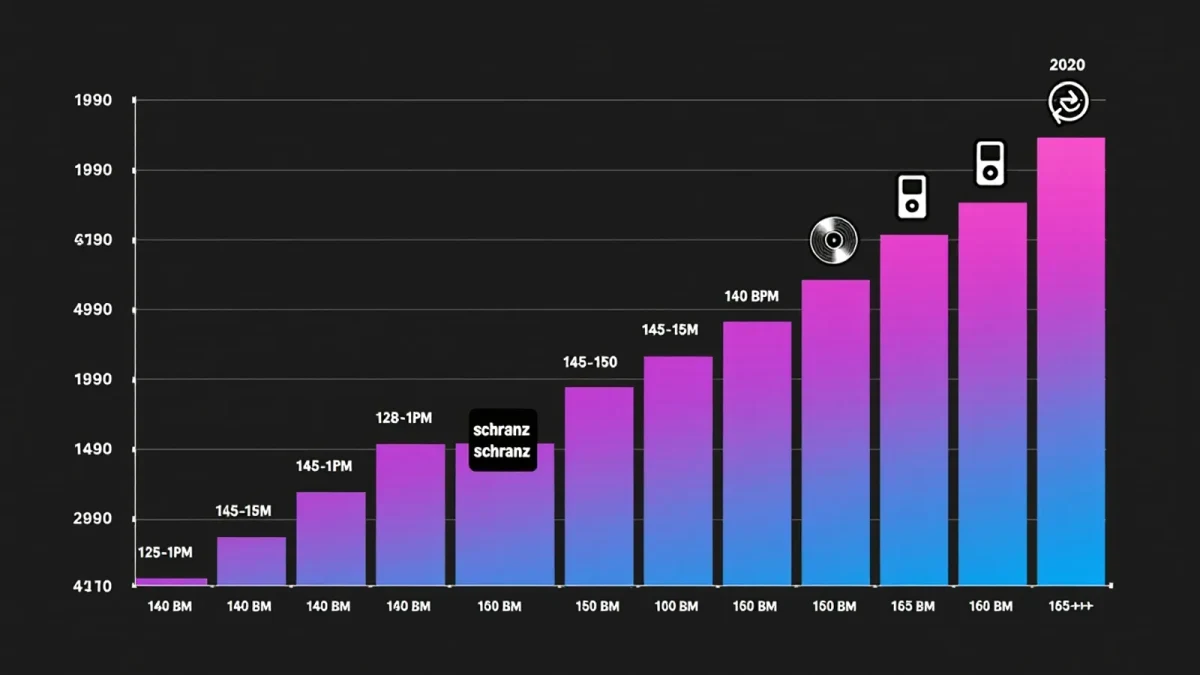
Hard techno is the high-velocity branch of techno defined by tempos from roughly 150 to 165-plus BPM, distorted or overdriven kick drums and a rave-revival aesthetic of goggles, gas masks and 1990s industrial imagery. Building on a thirty-year underground lineage, it crossed into the European club and festival mainstream between 2022 and 2024 and has held that position through 2025 — the fastest, loudest sound to top dance music's visible charts of the decade so far.
Where did hard techno come from?
Germany and the Netherlands, early, repeatedly. The first wave came in the 1990s, when producers pushed techno's then-standard 130-odd BPM upward into schranz — the harder German style named by Chris Liebing's turn-of-the-millennium scene — and industrial-techno offshoots. Early international compilations branded "hard techno" circulated through the 2000s at 145–155 BPM. This was utilitarian club music: functional, fast, unfashionable, sustained by a devoted continental circuit while the wider scene's attention moved to minimal, then EDM, then melodic techno.
The second, decisive wave arrived from 2022. A generation of young European DJs — many discovered through SoundCloud uploads and TikTok clips rather than club apprenticeships — fused hard techno's speed with 1990s rave signifiers, trance lifts and hardstyle's showmanship, and the sound detonated. By the 2023–2025 festival seasons, hard techno stages were among the most crowded real estate at major European events, and specialist stage brands and touring concepts built around the style multiplied across the continent's calendars.
What defines the hard techno sound?
Velocity plus distortion plus theater. The checklist:
- Tempo: 150–160 BPM is the modern standard band, with harder variants exceeding 165; classic techno's 128–140 now reads as "slow" to this audience.
- Kick: distorted, saturated, tuned loud — inherited from gabber and hardstyle as much as from schranz.
- Melody: hard trance's euphoric synth lines surface frequently; the 2020s style openly borrows 1998–2004 trance stabs and even full anthemic leads.
- Visuals: goggles, masks, spikes, cyber-industrial styling — a look deliberately recycled from 1990s hardcore and gabber, worn with varying degrees of irony.
Terminology, precisely: hard techno is not schranz, its grittier 2000s German ancestor, which rarely left the 145–150 range; not hardstyle, the Dutch mainstage genre at 145–155 with its signature reverse-bass; and not gabber or hardcore proper, which run 160-plus and descend from the 1990s Rotterdam line. The modern style deliberately blurs borders with all three — the crossover track, one era's niche, is this era's default.
Who leads the scene?
The names most associated with the boom are Belgian and international: Charlotte de Witte, whose KNTXT label and imprint ecosystem anchored the style's prestige tier and whose festival-headline standing through 2024–2025 made her its most visible ambassador; Amelie Lens, whose EXHALE parties carried hard-edged techno to arena scale; I Hate Models, the French producer whose emotional-hardcore fusions predated and predicted the wave; the Italian live act 999999999, whose peak-time anthems became the sound's festival currency; and Sara Landry, the Texan DJ whose dark, fast sets made her one of the genre's breakout names of 2023–2025. Around them, a wide roster — Azyr, Trym, Nico Moreno, Charlie Sparks and many others — sustains a release and touring pace that older, slower scenes cannot match.
Platform note, honestly framed: lineup-count and streaming metrics are imperfect proxies, but by 2024 the aggregate presence of these names on European festival posters was among the largest of any techno register, and the style's clip economy on short-video platforms is the primary engine of its youth audience — a first for a techno subgenre.
Why did hard techno take over?
Three forces converged. First, the post-pandemic intensity dividend: after two locked-down years, young audiences audibly preferred peak-time catharsis to build-and-release patience, and 150 BPM delivers the payoff continuously. Second, the platform loop: hard techno's visual staging — strobes, masks, crowd phones — clips extremely well, and short-video algorithms rewarded it with an audience growth curve that traditional club scenes never experienced. Third, fashion's industrial turn: the y2k-rave look circled back around in streetwear, making the genre's aesthetics retail-legible in a way minimal or tech house never were.
The contrarian view also deserves its paragraph: veterans argue the wave compresses dynamics, flattens set structure and burns out audiences — the same charges leveled at every acceleration in dance history, from happy hardcore to big room. Both things can be true. The sound is dominant and it is divisive, and it will not be the last genre of which that is said.
How does hard techno programming actually work at events?
Faster sets, shorter slots, higher staging. Where a house headliner might play two unhurried hours, hard techno bookings typically run sixty to ninety minutes at constant intensity, with the DJ functioning closer to a live act — long blends, big edits, planned peaks. Stage production leans maximal: synchronized strobes, CO2 jets and LED walls running industrial-graphics loops, because the audience expects a show with its tempo. Festival promoters responded by giving the style dedicated stages rather than scattered slots, and specialist concepts — mask-optional dress codes, y2k-rave decor, hardcore-leaning closing hours — turned those stages into mini-scenes with their own identities and return audiences.
The economy around it matured fast. Merch lines built on the genre’s visual language sell at rave-adjacent price points; a young generation of local openers now learns on hard-techno nights the way their predecessors learned on house and drum and bass; and event-series brands tied to the style’s leading names tour internationally with dependable sell-out rates as of 2025. Watch this space carefully: acceleration waves in dance music historically crest within three to five seasons. Whether hard techno consolidates like drum and bass did, or recedes like big room, will be one of the defining industry stories of the late 2020s.
What should you know before a hard techno night?
Logistics first. Sustained 150-plus BPM sets are physically demanding — plan hydration, breaks and realistic expectations for your knees. High-fidelity ear plugs are strongly advised: distorted kicks at festival SPL are unforgiving. Dress codes, where they exist, are more permissive than the styling suggests — goggles and masks are costume, not uniform; comfortable shoes are the actual requirement.
Listening at home: start with any KNTXT or EXHALE showcase set from 2023–2025 for the full production register, then the 999999999 live recordings for the peak-time ceiling, then I Hate Models' catalog for the style's emotional range. Follow the labels — KNTXT, Remain Records, and the harder ends of Filth on Acid and Infinite Machine — and you will never lack supply. The genre releases more music than any listener can hold; the filter is your stamina.