A club sound system is a chain that takes your mixer's output and turns it into acoustic pressure: booth monitors feed your headphones' reality, a processing stage protects and shapes the signal, amplifiers multiply it, and drivers — compression drivers, midrange horns, woofers, subwoofers — push it into the room. Understanding that chain makes you a better DJ immediately, because almost every booth decision you make — gain staging, EQ, where you stand, how loud you cue — is really a decision about the system. One health fact frames all of it: sustained exposure above roughly 85 decibels damages hearing progressively, per the U.S. National Institute on Deafness and Other Communication Disorders, and club systems routinely run far above it.
Mega Dance publishes information, not medical or engineering advice — protect your ears and defer to the venue's engineers.
What are the parts of a club PA system?
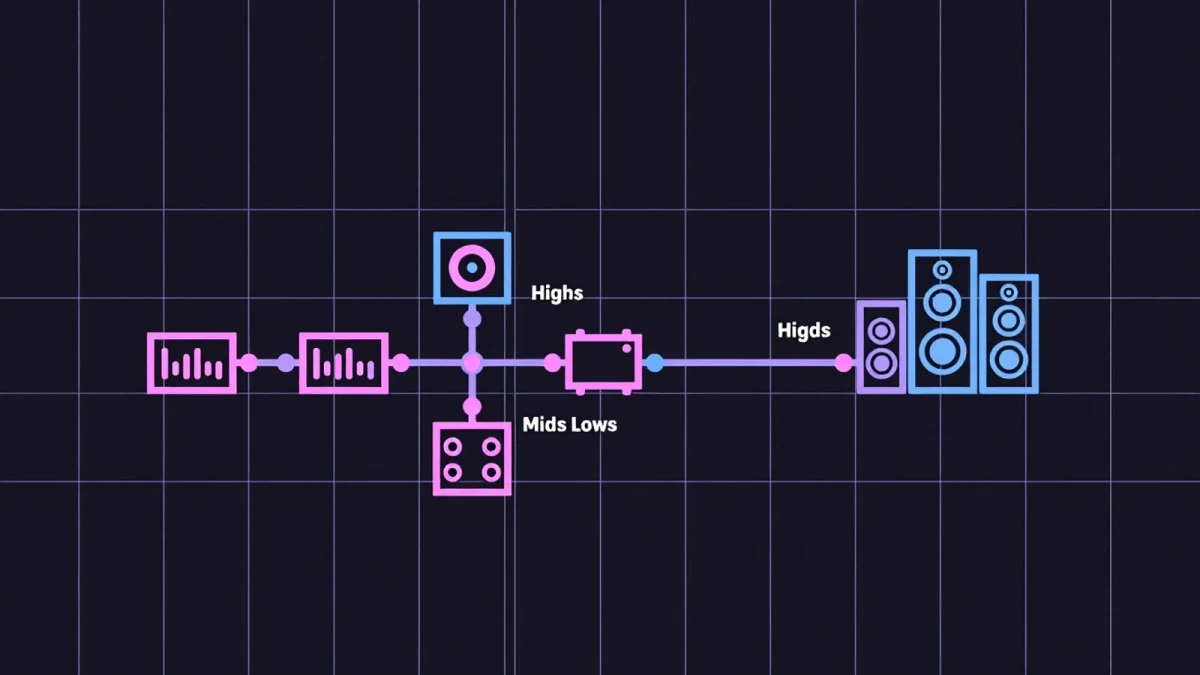
Work backwards from your ears. The booth monitors are the small speakers aimed at you, on their own volume independent of the main output — your control room. The main system splits the signal by frequency: compression drivers on horns reproduce highs, midrange drivers carry the body of the music, woofers cover low mids, and subwoofers — often a stack or flown array of large cabinets — reproduce the bass frequencies a dance floor physically feels.
Between mixer and drivers sits the processing and amplification stage. A crossover divides the signal into those frequency bands; limiters act as circuit breakers, capping peaks so a red-lined mixer cannot destroy drivers; amplifiers supply the power. Many venues also run corrective processing tuned to the room — the same physics that makes a concrete warehouse ring at 60 Hz and swallow 200 Hz.
How those boxes meet the room splits into two families. Point-source stacks — speaker stacks on either side of the booth or stage — dominate small and mid-size rooms. Line arrays — long vertical columns of coupled cabinets flown above festival stages — control where sound goes, throwing even coverage across a field while sparing the neighbours. Both families obey the same crossover-and-limiter logic underneath.
Why do rooms sound so different?
Because the room is half the instrument. Hard parallel surfaces — concrete, brick, glass — reflect sound, and reflected sound arrives at your ears milliseconds late, smearing bass and making some frequencies cancel or double depending on where you stand. That is why the same track sounds enormous at the barrier and muddy at the bar, and why the booth position in many clubs is acoustically the worst seat in the house: corners build up bass pressure, and booths live in corners.
System tuning answers the room. Venues with serious sound — and the scene keeps a public shortlist of rooms famous for it — invest in acoustic treatment, cabinet placement and DSP tuning so the system's response is flat at the dancefloor, not flat at the booth. Treated rooms let you hear your mix decisions; untreated rooms lie to you, usually by exaggerating low end where you stand.
The practical DJ lesson: trust the floor, not the booth. Walk the room early, listen from where the audience stands, and set your tonal balance against that reference — an old engineer habit that costs one song's length.
What is the DJ's job at the system's front end?
Your mixer is the system's first processor, and the two controls that matter most are gain and master. Keep channel and master meters out of the red: limiters will catch true peaks, but a persistently clipped signal arrives at the amps as distortion the system faithfully reproduces at volume. A clean, conservative output lets the room's processing do its designed job.
Respect the low end as shared property. Big subs reproduce everything you send, including the rumble below the kick that accumulates when two tracks' basslines stack; high-pass filtering the non-bass channel during blends is standard technique on serious systems, keeping the low end tight rather than bloated.
Then learn the venue's booth etiquette. The monitor volume is yours; the main system level is not — in many clubs the engineer sets a maximum and your master fader works within it. If the booth monitors are too quiet, ask for more monitor, not more master: cranking master to fix a booth problem just torments the floor.
How loud is a club, really?
Loud enough that hearing protection is a professional tool, not an accessory. According to NIDCD, prolonged exposure to sounds at or above roughly 85 dB — a level club dancefloors exceed for hours virtually everywhere — can cause gradual, permanent noise-induced hearing loss, and damage risk rises with every added decibel. Booth positions near monitors and sub stacks sit at the sharp end of that curve.
The countermeasures are boring and effective. High-fidelity earplugs attenuate evenly across frequencies, preserving the mix while dropping the level; the free alternative — foam — protects better but muddies detail, which is why working DJs pay for filtered plugs. Give ears quiet days between heavy nights, and keep headphone cueing volumes honest: cue level is the exposure you directly control, and cranked cueing is a classic early-career injury.
Watch the body's warning signs too — muffled hearing or ringing after a night is the cochlea filing a complaint. Chronic tinnitus is common among DJs who ignored decades of them.
How do you work with the venue's sound engineer?
Arrive early and introduce yourself; the engineer is the person whose decisions physically shape every note you play. Soundcheck if one exists, play a reference track you know intimately at working volume, and let them hear your tonal balance. State your needs plainly — more monitor, less sub in the booth — rather than fixing them secretly at the mixer's main output.
During the set, flag problems rather than fighting them. A ringing frequency, a dead monitor, sudden distortion: the engineer can see and fix the system from their position; you can only guess from the booth. And at the night's end, the same courtesy as with any crew: finish on time, leave the booth as you found it. The engineer remembers DJs who made the system look good — and promoters ask engineers, quietly, who was easy on the rig.
The system is the largest instrument you will ever play, and the only one you must share with everyone else in the building. Learn the chain, respect the meters, protect the ears — the low end will do the rest.