A festival lineup is a budget spreadsheet before it is a poster. Headliners are booked first and cost the most, the second and third tiers fill the gaps the headliners leave in the wallet, and local names fill the small stages as the money runs out. Understanding how festival lineups get built explains almost everything you see on the announcement — why certain DJs appear at five festivals in one summer, why the undercard is where the real booking happens, and why that one weird act sits third from top. This explainer reflects standard practice across the European festival sector as of February 2026.
Who actually decides who plays a festival?
Three roles, and they are not the same person. The booker (or booking team) chooses artists and negotiates fees. The promoter — sometimes the same company, sometimes a partner — owns the financial risk of the event. And the booking agency sits on the artist's side, negotiating up. At major electronic festivals, one head booker usually controls the main stage while trusted associates handle stages hosted by brands, labels or collectives — which is why a festival's small-stage lineups often read like a completely different, sharper event.
The power centre of gravity matters: an agency that controls several big DJs can bundle them — you want the headliner, you also take two roster acts at a softer combined rate. Bookers call these packages; fans call it why the same six names rotate all summer.
What does a festival lineup budget look like?
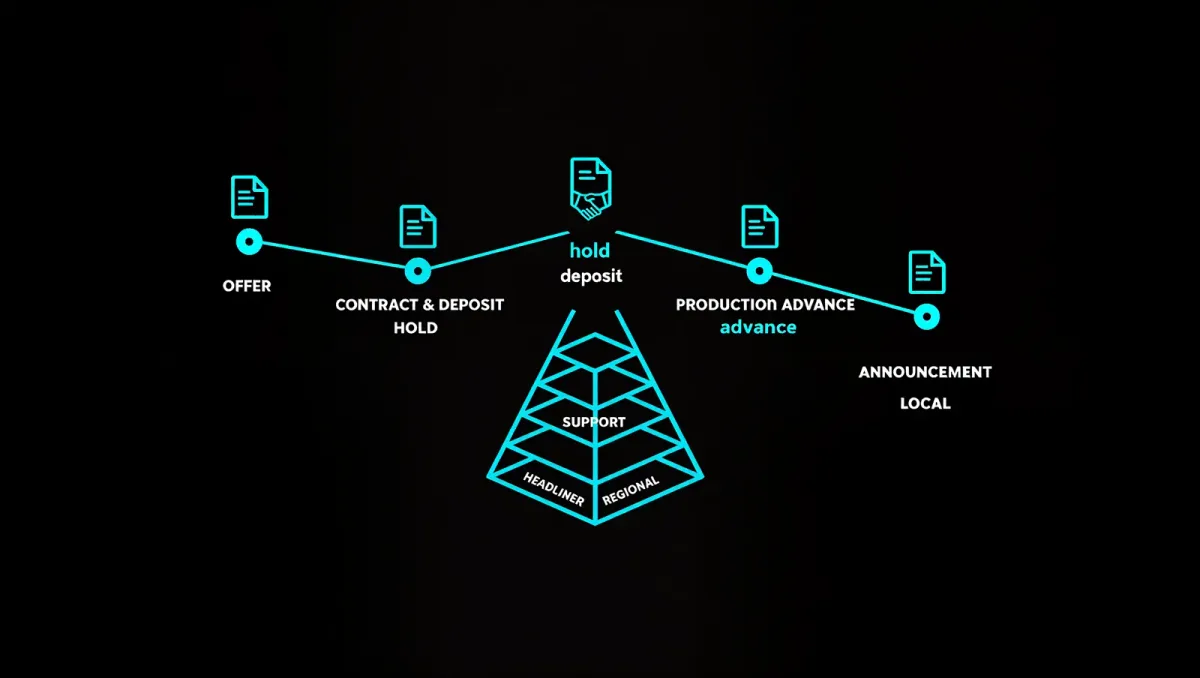
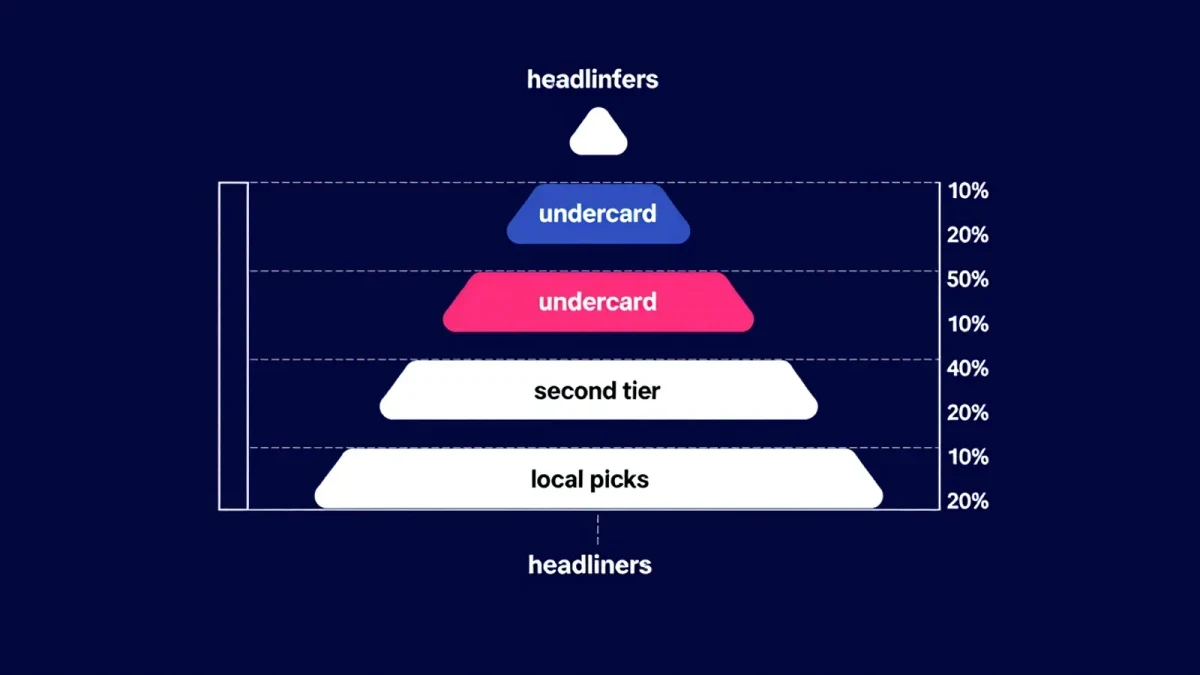
Think of the talent spend as a pyramid. Industry practice, consistent across interviews and published reporting on the festival business through 2025, looks roughly like this:
| Tier | Share of lineup slots | Share of talent budget | Booked |
|---|---|---|---|
| Headliners (top 2-6 names) | ~2-5% | 30-50% | 12-9 months out |
| Second tier (main support) | ~10% | 20-30% | 9-6 months out |
| Third tier / undercard | ~30% | 15-25% | 6-3 months out |
| Local and stage-host picks | ~55% | 5-10% | 4-1 months out |
The ratios shift by festival size and genre, but the shape holds: a tiny fraction of the names consumes roughly half the money, and the majority of the artists on the poster are playing for a fraction of what you'd guess.
How far in advance are headliners booked?
Farther than most fans imagine. Top-tier electronic headliners are typically locked nine to twelve months ahead — which means a festival announcing in January 2026 largely signed its top line in the first half of 2025. Exclusivity clauses are standard: an artist may be contractually blocked from playing within a radius (often 100-300 km) or a time window around the festival. That's why a certain DJ mysteriously cannot play your city all summer, then plays three nights there in November.
Why are lineups announced in waves?
Because announcements are marketing assets, not paperwork. A typical rollout as of the 2025-2026 season: dates and a teaser first, then the first names around early-bird ticket sales, then the full lineup drop timed to the general-sale push, then a final wave of stage hosts and one surprise addition weeks before doors. Each wave exists to hit a sales target. When you see a festival drip-feed names over three months, you are watching a cash-flow strategy in public.
What is a stage takeover and why does it matter?
A takeover means a label, brand or collective rents a stage and books it themselves — the festival gets content it didn't have to pay for, and the host gets a shop window. For electronic festivals this is where the sharpest curation happens: a respected label curating a stage will often book artists the festival's own booker would never risk on name recognition. Scan the takeover stages first when a lineup drops; the main stage will take care of itself.
How do bookers balance a lineup?
A finished lineup answers several conflicting briefs at once. It needs streaming-era headliners who sell tickets to casual buyers; scene credibility that keeps the core audience loyal enough to return next year; geographic spread for local radio and press; genre variety so the event isn't one crowd all weekend; and availability — the invisible constraint that kills the best ideas. Bookers also think in clash management: deliberately not scheduling two similar artists against each other, so the crowd splits politely instead of choosing angrily.
How much do festival DJs actually get paid?
Range, enormous. Across the electronic scene, published reporting and industry interviews through 2025 consistently place festival fees from a few hundred euros for a local opener to seven figures in rare global-headliner cases — with mid-tier touring DJs typically in the low-to-mid five figures per festival slot. Fees rise with chart momentum, streaming numbers and agent leverage; they fall for long sets, afterparties and showcase slots where the exposure is the payment. An opening slot at a major festival can legitimately pay less than the bar takings it generates.
How can you read a lineup like a booker?
Read the poster as a set of signals. The font-size hierarchy is the budget, made visible. Second-line names booked across several competitor festivals are agency bundles. A takeover stage with a label you respect is the highest expected-value booking on the site. And the gap between the announcement wave you loved and the final poster tells you where the money ran out — bookers fill the bottom of the pyramid last, with whatever budget remains. The names at the bottom are playing like it's an audition. Sometimes it is.
Do festivals ever change lineups after announcement?
Constantly, and the reasons are rarely dramatic. Visa problems, tour-routing shifts, illness and plain double-booking pull names off posters every season, and festivals replace them through the same agency networks that made the original bookings. The contractual etiquette is standard: the replacement slots in at an equivalent tier, and headline cancellations trigger the announcement wave the promoter hoped never to use. Follow-up announcements, refund windows and set-time changes live on the festival's official channels — treat any "rumoured to be playing" post as fiction until the poster itself changes.
Practical details: reading the next announcement
Format: evergreen explainer; sector practice described as of February 2026.
Signals to check: tier font sizes, agency clusters, takeover hosts, announcement wave timing versus ticket sales phases.
Rule of thumb: headliners locked 9-12 months ahead; undercard 3-6 months; final additions inside the last two months. All figures are indicative industry ranges, subject to change and to each festival's own deals.