Almost every bad festival queue is a timing error, not bad luck. Entry at large electronic festivals runs in predictable waves — gates open, the rush builds, security throttles flow, and the line empties in the mid-afternoon dead zone before the evening peak — and this festival entry strategy guide gives you the timing math, the packing decisions and the checkpoint behavior that put you on the field while others are still shuffling forward. Practice described reflects standard operations at major European festivals as of May 2026; every site's specifics vary and are subject to change.
Mega Dance publishes information, not legal advice — security staff decisions at the gate are final on site.
When do festival entry queues actually peak?
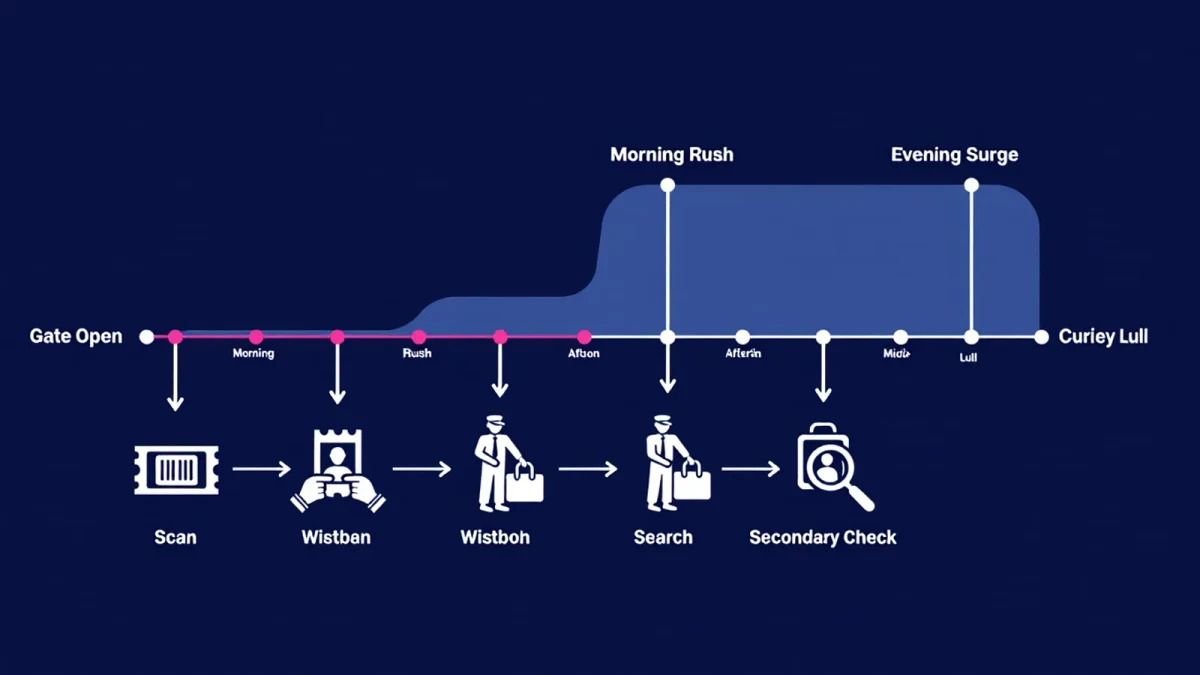
Twice a day, reliably. The first peak is the opening rush: at camping festivals, gates on arrival day see their longest lines from late morning through mid-afternoon as day-trippers, weekenders and luggage-laden campers converge; day festivals see a compressed version in the first two hours after doors. The second peak is the early-evening surge, when after-work arrivals and pre-headliner crowds stack up between roughly 17:00 and 20:00. The clear pockets sit mid-morning (campers, right at gate-open) and mid-afternoon, roughly 14:00-16:00, when the morning wave has processed and the evening wave hasn't arrived. If your ticket lets you choose arrival time, those two windows are the entire strategy.
What actually happens inside an entry checkpoint?
Four stages, and each one is a separate bottleneck. Ticket scan — fast, unless batteries or barcodes fail. Wristband fitting — staff do it properly, which takes 20-40 seconds per person. Security search — the real throttle: bag checks and pat-downs process people far slower than scans, which is why the line crawls exactly when it matters. Secondary checks — random full searches and dog units at some events, adding minutes for the selected few. The design lesson: your lane choice matters more than your position. Security lanes with big backpacks and coolers ahead of you move at half speed; lanes of people with pockets-only jackets flow. Count the bags, not the bodies, before you pick a lane.
What should you leave behind to clear security fast?
Everything on the banned list, plus everything arguable. Glass of any kind — bottles, mirrors, perfume — sealed drinks in glass, opened liquids, anything with a blade, drones without accreditation, professional camera gear without a photo pass, and anything in quantities that suggest resale. The full list is published per festival; read it the night before, because the bin at the checkpoint is the most expensive bin in the venue — confiscations are not returned. Pack transparent where you can: a see-through bag or open-top tote gets a glance instead of a rummage. Decant toiletries into plastic. Cigarette packs get opened — sealed cartons read as commerce. Every one of these details saves the eleven people behind you their patience too.
How early should you arrive for the headliner?
Work backwards with real numbers. At large sites, peak entry from the back of the line to the field can run one to three hours, plus 15-25 minutes to walk to a main-stage spot worth holding. So for a 22:30 headliner at a day festival with evening surge conditions, being in line by 19:30-20:00 is the honest margin; at a camping festival already on site, the same headliner needs only the walk and a crowd-absorption buffer of 30-45 minutes for a decent front-half position. The error almost everyone makes is budgeting the queue they saw at 15:00 and then arriving into the 18:30 version of it — surges can double wait times within an hour.
Does fast-track or VIP entry actually save time?
Usually yes at peak, marginally at off-peak. Fast-track lanes cut the queue length, not the checkpoints — you still scan, still get searched, still have a wristband fitted, so the saving is the wait, typically the majority of total entry time at peak and a rounding error at 14:00 on a Tuesday-few attendance day. As of the 2025-2026 season, fast-track entry bundles are common paid add-ons at large European festivals, per their published ticket tiers. Whether it's worth it depends on your arrival discipline: a punctual general-admission guest beats a late fast-track holder every time the gates are quiet.
What makes a queue move faster for everyone?
Small mechanics, compounding: have your ticket QR code open and screen brightness up before you reach the scanner; take your hat and belt off while waiting, not at the pat-down; open every zip before the searcher asks; keep your group in one party, not a wave of six arriving individually at the front; and put phones away once scanned so the whole lane isn't re-blocking at the fitting station. If you're the organized one, use the wait: suncream on, earplugs into pockets, site map photographed, meeting point agreed — the queue is the last calm place you'll have for hours.
How do you handle entry with kids, access needs or luggage?
Use the lanes built for it. Most major festivals operate accessible-entry lanes and family or assisted gates, per their published accessibility information, and campers with heavy loads are usually better served by drop-off zones and trolley hire than by the standard lanes. Register access needs in advance where the festival offers it — accessibility passes are limited and processed ahead, not on arrival day. For luggage-heavy camping arrivals, the tactic that works is the split: one person holds the queue position in the campers' lane while the other ferries loads from the car park. Two trips through a quiet mid-morning lane beat one trip through the noon crush.
What about leaving — is exit a strategy too?
Yes, and it's the mirror image. Exit surges happen at the final track and at curfew, when an entire site moves at once toward gates, shuttle stops and car parks. Leave ten minutes before the closer ends and you'll trade 600 seconds of set for an hour of queue — or stay for the full fireworks, let the first wave clear over a last drink, and walk out into a thinned crowd. At camping festivals, the Monday-morning exit is its own event: pack the night before, agree a driving roster, and eat before the traffic, because the on-site food leaves with the site.
Practical details: entry timing plan
Format: evergreen strategy guide; operations described as of May 2026, subject to change per event.
Best windows: gate-open for campers; 14:00-16:00 for day arrivals; before 19:30 for a 22:30 headliner at peak conditions.
Kit for speed: transparent bag, decanted toiletries, no glass, ticket QR ready, belt off, one group party.
Check before travel: the event's banned list, fast-track tiers, accessible-entry registration and gate opening times.