Festival systems are loud enough to damage your hearing in a single weekend, and the fix costs less than a beer round. Major festival systems run well above 100 dB near the front, a range at which safe exposure is measured in minutes per day by occupational health standards — per the U.S. CDC's noise guidance, sounds at 100-110 dB risk permanent damage inside roughly 2 to 15 minutes unprotected. This festival ear protection guide explains what happens in your ear, which plugs actually keep music clear, and how to build the habit.
How loud are festivals, really?
Measurements at electronic events consistently land in the 100-110 dB range close to front-of-house and the barrier, with bass-heavy genres adding intense low-frequency energy that you feel as much as hear. Those numbers sit far above the 85 dB threshold that occupational health bodies treat as the start of the risk zone for an eight-hour day — and festival days run 8-12 hours. The trap is that damage isn't pain-driven: ears don't hurt the way skin burns. The warning signs are the muffled, pressurized feeling after a set and the high-pitched ring in quiet rooms afterwards. That ringing — tinnitus — is the sound of cochlear hair cells that will not grow back.
What actually gets damaged in your ear?
Sensorineural hearing loss, the festival-relevant kind, happens in the cochlea: loud sound overworks the sensory hair cells that convert vibration into nerve signals, and sustained overexposure kills some of them permanently. Human ears don't regenerate those cells, which is why the loss is cumulative, invisible in year one and unmistakable in year ten. Two mechanisms matter: the dose stacks across hours and days, and it stacks across years of attendance — the weekend you protected in your twenties pays off in your forties. There's no training effect, no toughening. Loud is loud, every time.
Do earplugs ruin the music?
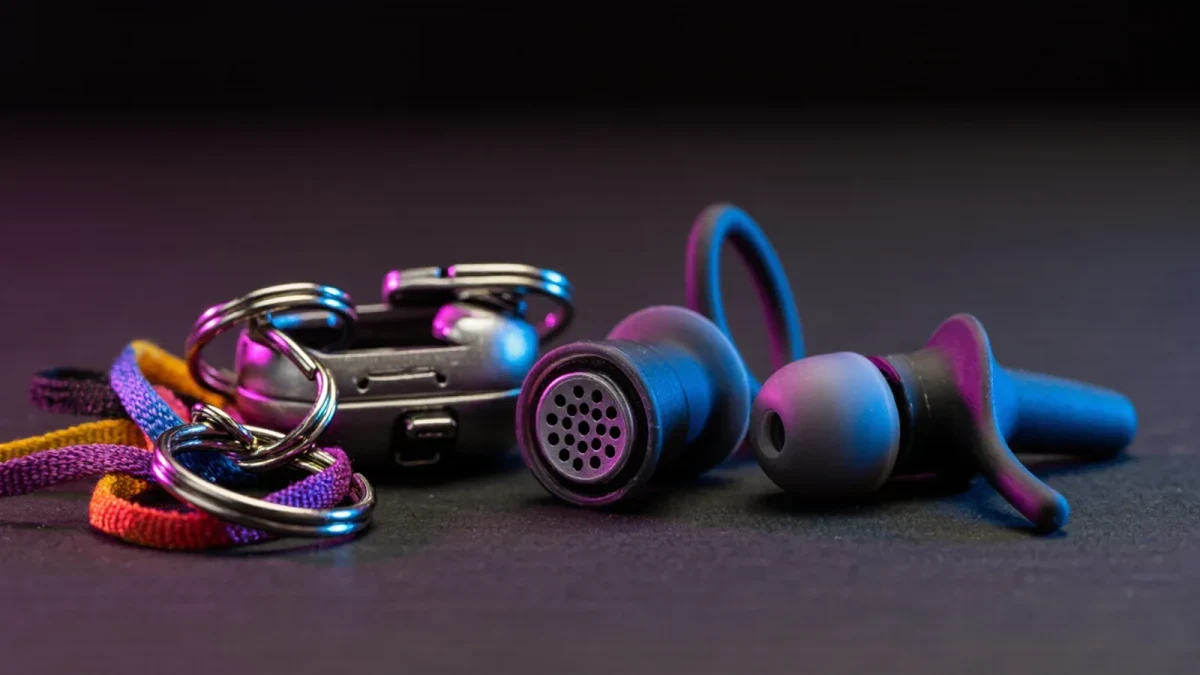
Foam ones do, mostly. Standard foam plugs cut high frequencies hardest, which is why the hi-hats vanish and the vocals go underwater. High-fidelity filters — the class sold for musicians and club-goers — use a tuned acoustic path to attenuate roughly evenly across the spectrum, dropping overall level by a fixed amount (commonly 9-25 dB depending on filter strength) while keeping the balance intact. For most festival floors, a moderate filter around 15-17 dB is the sweet spot: conversation stays possible, mixes stay coherent, and the dose drops out of the damage zone. Custom-moulded versions from an audiologist seal better and last years; universal-fit versions from reputable audio brands cost about the same as two drinks and live in your keyring case. Foam still beats nothing — it's the emergency fallback, not the plan.
| Option | Typical attenuation | Sound quality | Cost level |
|---|---|---|---|
| Unprotected | 0 dB | Full, briefly | Hearing, later |
| Foam plugs | ~25-33 dB | Muffled highs | Very low |
| Universal hi-fi filters | ~9-25 dB | Balanced | Low |
| Custom moulds | Filter-dependent | Balanced, sealed | Moderate |
How do you build the protection habit?
Friction is the enemy, so remove it. Keep one pair on your keyring or in the same pocket as your wristband cash card — the object you never lose carries the plugs you must not lose. Put them in at the first stage of the day, not the loudest: by the time you notice you need them, the dose is already stacked. Store them on a leash or lanyard during set changes, because festival floors eat loose plugs. Buy a second cheap universal pair as the backup in a different pocket. And do the quiet test each morning of a multi-day event: sit somewhere silent for a minute; if you hear ringing or dullness that wasn't there before, that's your cue to run quieter that day — further back, more breaks, plugs in all day.
Where you stand changes your dose
Level drops with distance, so position is dosimetry. The barrier and the speaker stacks are the hottest zones; the tuned sweet spot 20-40 metres back near front-of-house is often a few dB kinder to your ears than the crush at the rail while sounding better. Beside delay towers and directly under balcony edges, overlapping arrivals smear the low end and add perceived loudness without adding musical information. Add deliberate quiet hours: a meal away from the stages, a chill-out zone set, the walk between fields. Your ears metabolize nothing — recovery between exposures limits the creep of permanent shift, but it doesn't refund the dose already taken.
What about headphones, in-ears and afterparties?
Personal audio stacks onto festival dose more than people think — the commute with earbuds at high volume is part of the same week's exposure. The disciplined pattern is one loud environment at a time: if the day was heavy, the journey home runs at low volume or open-air. For DJs and frequent clubbers, in-ear monitors with controlled output are the professional standard precisely because they cap dose while keeping cues clear. And the afterparty in a small room with a wall of speakers is frequently louder per square metre than the main stage was — the 6 a.m. basement is where the weekend's budget gets overspent. Same rule everywhere: plugs in before the first kick drum, not after the first warning sign.
When should you see a professional?
Any ringing lasting more than roughly 24-48 hours after an event, muffled hearing that doesn't clear, ear pain, or a sudden drop in hearing on one side — those are the published red-flag symptoms that warrant prompt audiological assessment. A baseline hearing test as a regular attendee is also reasonable housekeeping: it makes future changes measurable instead of anecdotal. Early intervention matters; the standard advice across health bodies is that noise damage is permanent but its progression is entirely preventable.
Practical details: protection kit and habits
Dose rule: unprotected exposure above ~100 dB risks damage in minutes; a 15-17 dB hi-fi filter moves a festival day back toward survivable territory.
Kit: universal high-fidelity earplugs with case on the keyring, foam backup pair in another pocket, leash for set changes.
Position: 20-40 m back near front-of-house rather than the barrier; quiet hours between heavy sets.
Red flags: ringing beyond 24-48 hours, persistent muffled hearing, pain, one-sided loss — see an audiologist. Guidance as of June 2026; standards evolve, so check current health-body advice.