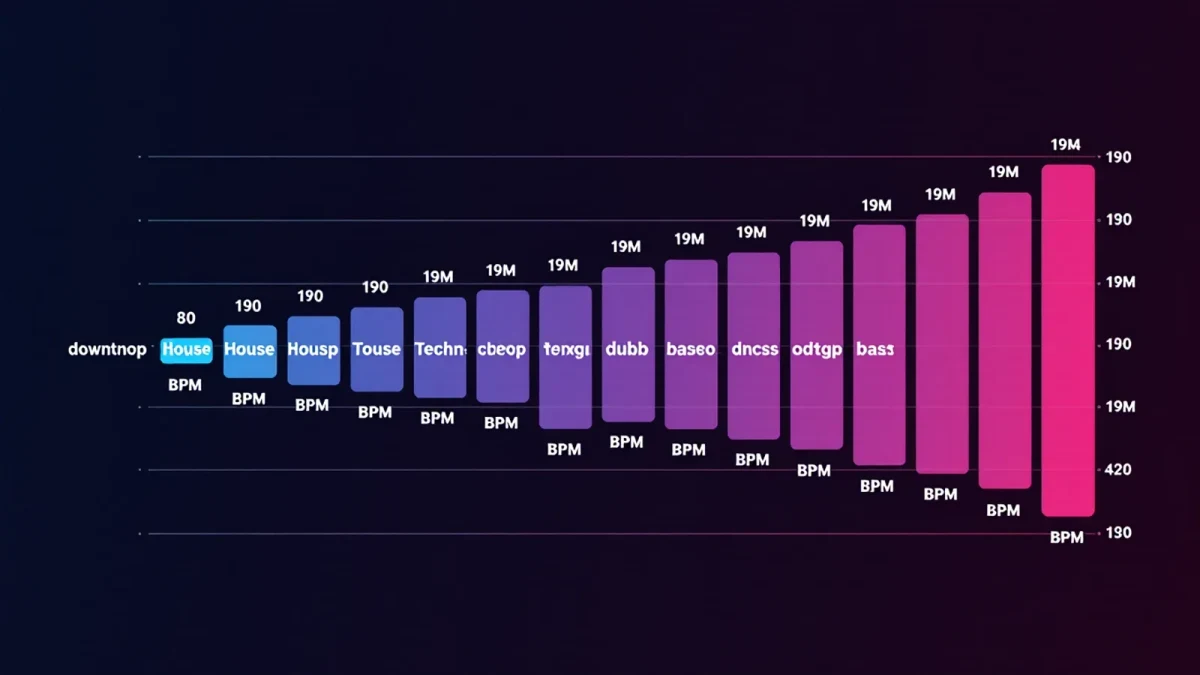
Most electronic genres live inside narrow, well-policed tempo bands: house near 124, techno near 130, dubstep near 140, drum and bass near 174. This cheat sheet collects the standard BPM ranges for every major style as producers and DJs actually use them in 2025, explains why the bands matter for beatmatching, and shows how to read tempo when you are digging, playlisting or programming a set.
Why do genres cluster at specific BPMs?
Body mechanics and inheritance. Dance tempos sit where human locomotion feels natural — a brisk walk is around 120 steps per minute, a jog around 140, a sprint above 170 — and each genre locked into the band that suited its dance style. Inheritance does the rest: every genre descends from one that already had a tempo, and offspring nudge rather than leap. Drum and bass doubles the 87 BPM half-time feel of hip-hop; dubstep slows drum and bass's energy to 140; hard techno inherits techno's 130 and pushes it to 150 and beyond in the 2020s wave.
A caution before the table: these are conventions, not laws. Plenty of canonical tracks sit outside their genre's standard band, and modern production — especially the tempo-fluid club music of the 2020s — treats BPM as a starting suggestion. Use ranges to navigate, not to gatekeep.
What is the full BPM cheat sheet?
The bands below reflect producer and DJ practice as of 2025; overlap between neighbors is normal and the borders are conversational.
| Genre | Typical BPM | Feel / drum signature |
|---|---|---|
| Downtempo / chillout | 80–105 | Head-nod, spacious |
| Hip-hop instrumentals | 85–100 | Swung boom-bap |
| Afro house | 115–125 | Polyrhythmic, percussion-led |
| Deep house | 118–122 | Soft four-to-the-floor |
| House | 120–128 | Four-to-the-floor, groovy |
| Tech house | 124–128 | House skeleton, techno tools |
| Electro (Miami bass lineage) | 125–135 | 808 breaks, machine funk |
| Techno | 128–140 | Driving four-to-the-floor |
| Hard techno | 145–160 | Distorted kicks, fast hi-hats |
| Trance | 132–142 | Builds, melodic arcs |
| Hardstyle | 145–155 | Reverse bass, big drops |
| Psytrance | 145–150 | Rolling bass, hypnotic |
| UK garage | 130–135 | Shuffled 2-step |
| Bassline / 4x4 garage | 135–140 | Bouncy, bass-led |
| Dubstep (UK) | 138–142 | Half-time, sub-heavy |
| Grime | 138–145 | Square riddims, MC-led |
| Dubstep (US / brostep) | 140–150 | Half-time, mid-range growls |
| Hardcore / gabber | 160–190 | Distorted kick overload |
| Jungle | 165–175 | Chopped breaks, ragga bass |
| Drum and bass | 170–175 | Rolling breakbeat, half-time snare |
How do DJs use BPM when building a set?
As a corridor, not a cage. The classic rule: keep transitions within roughly 6 percent of the current tempo — beyond that, pitch-shifting becomes audible and the groove of the incoming track distorts. From a 124 BPM house track, that corridor reaches about 117 to 131, letting you slide into techno but not into drum and bass. Crossing larger gaps requires a tool: a breakdown, a double-time switch (a 140-BPM track blends into 70-BPM half-time), or the oldest trick in the book — a snare-roll build while you slam the fader.
Genre borders are where sets get interesting. The 128–135 band lets house, tech house and techno flow freely — which is exactly why those genres share so many lineups. The 138–145 cluster (dubstep, grime, bassline, psytrance, hard trance) cross-pollinates readily at the same numeric tempo despite wildly different drum feels. And drum and bass DJs exploit the half-time illusion: a 174-BPM track reads as 87 to your body, which is why hip-hop and DnB pair more easily than their numbers suggest.
How do you find a track's BPM?
Four ways, in ascending order of effort.
- Software: Rekordbox, Traktor, Serato and Mixed In Key all analyze BPM automatically on import — the standard workflow.
- Streaming/DSP metadata: Beatport and Bandcamp list BPM per track; Spotify does not, but third-party tools estimate it.
- Manual count: count the kicks for 15 seconds and multiply by four. Rough, fast, good enough to classify.
- Tap tempo: any tap-tempo app against the kick; accuracy improves with a full minute.
A caveat on automated analysis: half-time genres confuse it. Analysis may report a dubstep track at 70 rather than 140, or a drum and bass tune at 87 rather than 174 — the software sees the felt pulse, not the genre convention. When two tracks in the same genre disagree by exactly a factor of two, that is the tell.
Do tempos drift over time?
Yes, and the 2020s have been a live demonstration. Between roughly 2021 and 2025, the visible club mainstream — hard trance, hard groove, hard techno — pushed standard set tempos from the long-standing 125–135 window into sustained 145-plus territory at many European events, a shift widely discussed by DJs and festival programs through 2024–2025. Whether the pendulum swings back is dance music's perennial cliffhanger; the tempo bands in the table above will absorb it either way, because the genres themselves outlive their tempo fashions.
The other durable drift is downward at the slow end: downtempo and ambient-adjacent club music gained serious programming space in the 2020s, giving openers and closers more room than the old warm-up orthodoxy allowed.
What about tempo and energy — is faster always harder?
No, and trusting BPM alone will wreck a set. Energy lives in density, dynamics and arrangement as much as in tempo. A 122-BPM deep house record with a rolling groove can lift a room more than a flat 150-BPM trancer; a half-time 140 dubstep drop hits harder than a busy 128 techno loop because of the space around the hit, not the number on the readout. Veteran programmers read two axes — tempo and intensity — and move them independently: you can drop intensity while holding tempo to give a floor breath, or raise intensity at the same BPM by tightening percussion and opening the filter.
Practical drill if you are learning: tag your library with both BPM and a simple energy score of one to five. After a month you will start seeing the pairs that work — the 124/3 house record that hands off cleanly to the 126/4 techno tool, or the 140/5 dubstep switch that resets a tired room. The cheat sheet tells you whether a blend is possible; your energy tags tell you whether it makes sense.
How should you memorize any of this?
Do not memorize — anchor. Five numbers cover the whole map: 120 (house), 130 (techno), 140 (dubstep and friends), 150 (hardstyles and psytrance), 174 (drum and bass). Every other genre is a neighbor of one anchor. When you can call those five, you can place any track you hear within a genre family before the first bar finishes — which is, in the end, the actual party trick the cheat sheet trains.