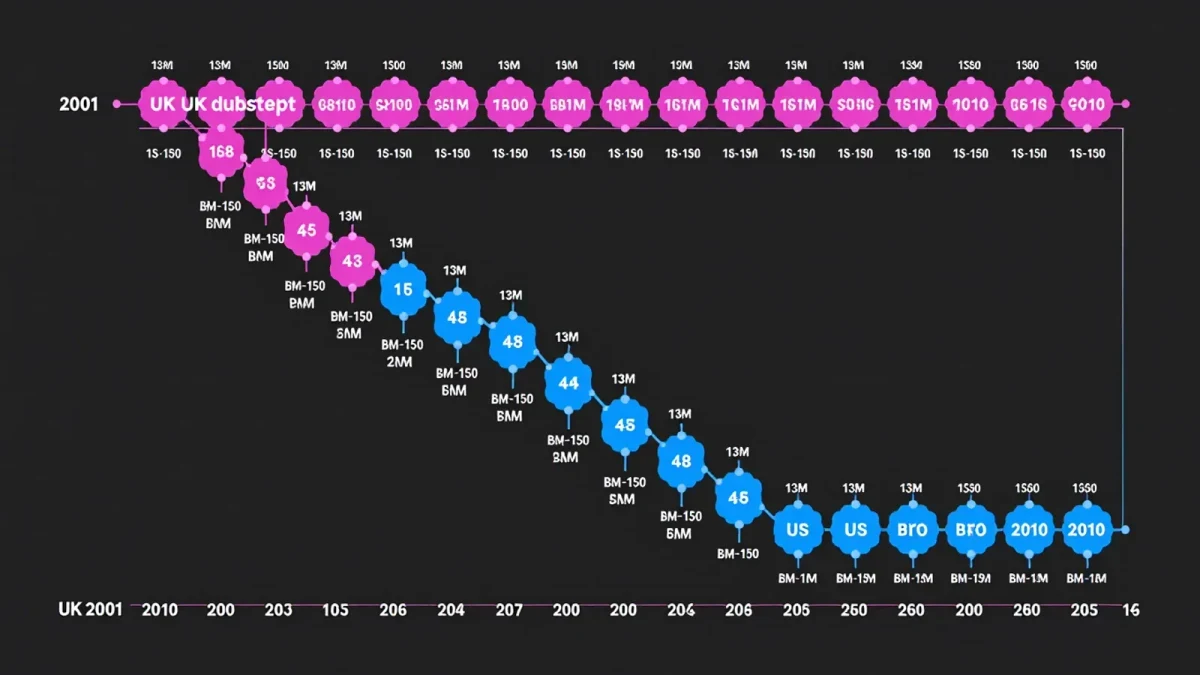
Dubstep is a genre of electronic dance music built around a slow, heavy half-time rhythm at roughly 140 BPM, massive sub-bass and space between the drums. It was born in South London around 2001–2004, peaked as a UK underground movement by 2008, and then fractured into two lineages: the meditative original style and the aggressive, arena-filling American variant that dominated the early 2010s.
Where did dubstep start?
Croydon, mostly. The genre grew out of UK garage's darker 2-step offshoots at the turn of the millennium, nurtured by two record shops — Big Apple Records and its small scene of regulars — and by a young producer named Skream, who was making tracks in his brother's studio while still a teenager. The word itself first appeared in print around 2002, coined on the Grooverider-hosted, BBC-aired scene forum era of naming nights.
The decisive institution was FWD>>, a club night founded at London's Velvet Rooms in 2001 by Sarah Lockhart and Ammunition Promotions before moving to Plastic People in Shoreditch, a room of barely 200 capacity. FWD>> gave the sound a home, a resident DJ trio of Hatcha, Youngsta and later Kode9, and a weekly testing ground for dubplates. Plastic People's famously precise sound system mattered as much as the tracklist: dubstep was written for sub-bass you feel in your chest, and that room delivered it.
What does original dubstep actually sound like?
Slow, sparse and heavy. The template: a 2-step-inherited drum pattern with the snare landing on the third beat, giving a lurching half-time feel at 138–142 BPM; long, tectonic sub-bass notes; and — critically — space. The early masters, Skream, Benga, Digital Mystikz and Loefah, left holes in the arrangements where other genres would stack percussion.
Two releases codified the era. Skream's "Midnight Request Line" (2005), a melody of pitched-up phone-like tones over a lurching sub that crossed the genre over to listeners who had never set foot in Croydon. And Burial's Untrue (2007), an album of cracked vocal samples and rain-slick ambience that remains one of the most critically acclaimed electronic records of the century — it was nominated for the Mercury Prize in 2008 and later placed in best-of-decade lists by outlets including BBC Music and The Times.
Glossary for newer readers: a "dub" in this context is a version of a track stripped back for soundsystem play, inherited from dub reggae; a "wobble" is a bassline modulated in rhythm, the element later inflated into the genre's most recognizable — and most caricatured — feature.
How did dubstep conquer America?
Through one man's coast-to-coast enthusiasm and one Liverpool producer's synth. In 2010 the documentary-style circulation of clips from UK nights met its match when Rusko's "Cockney Thug" and Caspa sets crossed to US audiences; the decisive accelerant was Skrillex, whose 2011 EPs Scary Monsters and Nice Sprites and Bangarang rebuilt dubstep around mid-range bass growls, metal-inherited aggression and EDM-scale drops. Scary Monsters won two Grammy Awards in 2012 and again in 2013 for its title track's remix category wins — the moment the genre's commercial ceiling was set.
The numbers of that boom are still startling. Major festivals added dubstep headliners between 2011 and 2014, and the American variant — dubbed "brostep" by critics — became the default sound of bass music for a generation of US fans raised on it. British originators were, publicly and repeatedly, split on the direction. In a widely circulated 2012 interview with Sephirot-adjacent press, Burial's and Kode9's label Hyperdub simply steered elsewhere, while producers like Skream moved toward house and disco sets by the mid-2010s.
Did dubstep die after the boom?
No — it bifurcated. The commercial wave receded after roughly 2014, when EDM festival programming diversified, but two healthy scenes survived it. In the UK and Europe, the original-register sound continued through labels like Tectonic, Deep Medi (founded by Mala of Digital Mystikz) and Tempa, the label that had released much of the founding catalog. In the United States, the aggressive lineage evolved rather than vanished — a slower, heavier descendant sometimes called riddim, and a broader bass-music continuum that still headlines festivals as of 2025.
The reunion tour nobody planned: by the 2020s the originators were being re-booked at prestige levels. Skream's house-and-disco pivot made him a double-genre draw; Youngsta and Kode9 kept the founding repertoire alive at clubs and festivals like Dekmantel; and "Midnight Request Line" had become the kind of track that closes festivals two decades on.
How is dubstep different from its relatives?
Genre terminology exact, as ever. Dubstep is not drum and bass: DnB runs near 174 BPM with rolling breakbeats, dubstep near 140 with half-time snares. Dubstep is not garage, its parent: UK garage swings at 130–135 with shuffled 2-step drums and brighter soul. And dubstep is not grime, its sibling — grime is an MC-led genre at roughly 140 BPM built on riddims and lyrical sparring, where dubstep is primarily instrumental soundsystem music. They share family features and were born in the same post-garage London moment, which is exactly why playlists blur them.
| Genre | Tempo | Drum feel | Defining voice |
|---|---|---|---|
| UK garage | 130–135 | Shuffled 2-step | Vocal chops, swing |
| Grime | ~138–145 | Square, riddim-led | MC, staccato synths |
| Dubstep (UK) | 138–142 | Half-time, sparse | Sub-bass, space |
| Dubstep (US) | 140–150 | Half-time, maximal | Mid-range growls, drops |
| Drum and bass | 170–175 | Rolling breakbeat | Breaks and reese bass |
Why did the genre split so hard?
Physics and economics, in that order. Original dubstep was written for small rooms with serious sub-bass systems — Plastic People famously insisted on low volume on the floor but devastating low end. The music’s signature frequencies live below 60 Hz, which small clubs reproduce well and which phone speakers and laptop speakers cannot reproduce at all. When the sound crossed to America’s festival fields, producers facing 20,000-capacity crowds and streaming playback on earbuds moved the action upward into the mid-range, where growls and yoi basses read on any system. Same skeleton, different center of gravity.
Economics finished the job. The 2011–2014 EDM boom paid producer-DJs at rates UK underground artists had never seen, and the sound that won those slots was the loud one. Purists grumbled — some loudly — but the split also protected the original style: by 2015 the UK lineage had retreated to the kind of 300-capacity rooms and boutique festival slots where it had always made the most sense. Both scenes emerged healthier for the divorce.
Where should a newcomer start?
Three records, three eras. Skream's self-titled 2006 album for the founding sound. Burial's Untrue (2007) for the art-music branch. Skrillex's Scary Monsters and Nice Sprites (2010) for the mutation that took it global. Listen in that order and you will hear one genre become three — which is, in the end, the whole story of dubstep in a single playlist.