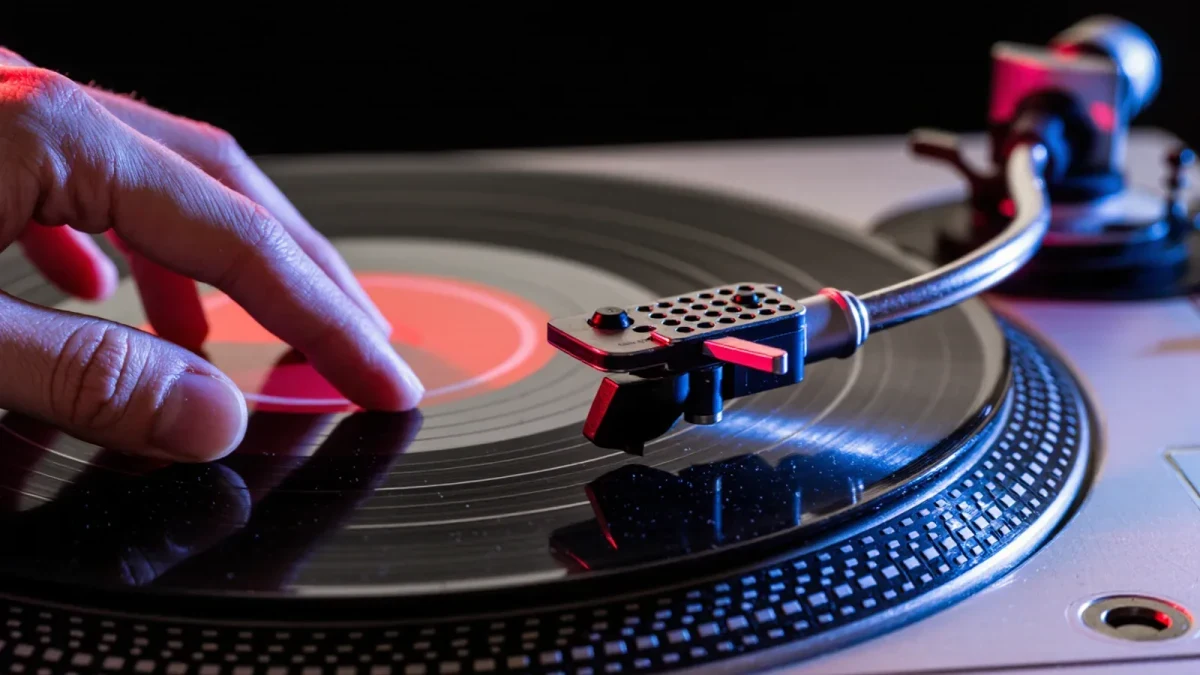
Beatmatching by ear means matching two tracks' tempos and aligning their beats using nothing but your ears, the pitch fader and your hands on the platter. You can learn it in weeks with focused practice: the method is cue the first beat, release in time, correct drift with your fingers, ride the pitch until the tracks hold together unaided. It remains the skill that keeps a DJ working when sync meets an ungridded bootleg, a live drummer or a worn pressing — which is to say, forever.
This guide teaches the technique; ten minutes of daily deliberate practice beats two hours of distracted button-pushing.
Why learn beatmatching when sync exists?
Because sync assumes a correct beatgrid, and real libraries are full of tracks that don't have one. Vinyl rips of 1990s house, bootleg edits, live percussion jams, older jungle pressings cut before tight digital quantisation — sync chokes or wanders on all of them, while an trained ear simply rides the pitch. Vintage drum & bass and garage records were played on turntables by people matching by ear, and the music still expects that treatment.
There is also the booth reality: mid-set problems are tempo problems. A grid that is off by a hair, a tempo readout that is flat wrong, a breakdown where the kick vanishes and the screen stops helping. The DJ who can hear phase — whether a beat lands early or late — fixes it in a bar. The DJ who can't watches the room drift.
And there is craft pride, which the scene does not apologise for. Ear matching is the difference between playing records and operating equipment.
What do you need before you start?
Two tracks with clear, steady four-on-the-floor kick drums at similar tempos — think two house records within three BPM of each other. Clear kick patterns make phase errors obvious to a beginner ear; broken beats hide them. Avoid tracks with long beatless intros for the first weeks.
Any hardware with a pitch fader and a way to touch the music: turntables, CDJs or a controller with jog wheels — turn the sync function off, because the lesson is the ear. Headphones that seal, so the cue track isn't polluted by the master. And a quiet space: learning phase means hearing tiny timing differences, and a loud room teaches nothing.
Set your pitch fader range to a moderate width such as ±6 or ±8 percent if the hardware allows. Narrow ranges give finer control while you learn; wide ranges rush your corrections.
What are the steps to match a track?
- Cue the first beat. With the incoming track stopped, find its very first kick, hold the platter or pause on the beat, and rock gently to feel its pulse against the playing track's kick in your headphone ear.
- Release on the beat. Let go exactly as the live track's kick fires. Your first release will be early or late — everyone's is. What matters is what you do next.
- Identify the drift. Listen for two or three bars. If the incoming kick arrives before the live one, the incoming track is fast; if it trails, it is slow. This diagnosis is the entire skill — everything else is mechanics.
- Correct with your hands. Speed the record with a fingertip on the label or spindle, or slow it with a gentle platter touch, to bring the kicks back into line. This is a temporary nudge, not the fix.
- Ride the pitch. If the track was running fast, move the pitch fader slightly down — then immediately make a small opposite nudge with your hand, because the pitch change has now over-slowed the track. The hand correction and pitch adjustment must balance.
- Repeat and let go. Drift again, correct again, smaller each time. When you can release the music for sixteen bars and hear no drift, the tempos are locked.
- Confirm in the mix. Blend low-cut in the headphones against the master. If the composite kick sounds like one drum for a full phrase, you have matched it.
The rhythm of step five — pitch adjustment plus compensating nudge — is what beginners call hard and what working DJs call Tuesday. It becomes automatic at roughly the speed you learned to change gears in a car.
How do you hear whether a beat is early or late?
The trick has names — the galloping test, the flam test. Two kicks a few milliseconds apart sound like a single fat drum: in phase. Two kicks further apart sound like a gallop or a flam from a snare roll: out of phase. When the incoming kick hits first, you hear the flam slightly bright, ahead of the pulse; when it trails, the flam sounds like an echo dragging behind. Learn the flavour of early versus late and correcting becomes reflex.
Practical cues help while the ear trains. Watch the platter or jog wheel stall as kicks land, use the CDJ's beat display as a roughometer, then look away — screens are training wheels that rot if you keep them past the point they helped.
Practice drills shorten the distance. Match two copies of the same track, which removes key and rhythm variables. Then two tracks three BPM apart, then six. Then match with the headphone cue only in one ear, then split cue. Two weeks of ten-minute drills moves most learners further than months of casual mixing.
How long does learning take, honestly?
With daily deliberate practice, most learners get a reliable basic match in two to six weeks, and comfortable fluency — matching inside eight bars without panic — within a few months. Vinyl adds a physical layer: hand control on a slipping platter is its own education, and turntable DJs typically add weeks for the touch alone.
Fluency also decays without use, which is why so many CDJ-era DJs still rehearse ear matches on quiet nights. Treat it like fitness, not a diploma.
When is it fine to use sync?
Honestly: often, and the scene's working pros do. Once ear matching is in your hands, sync is a legitimate tool for complicated workflows — layering three decks, running remix decks, holding long blends while you work effects and loops. The problem has never been the button; it is the button as crutch replacing a skill the booth will one day demand.
The working rule: if you could match it by ear in a reasonable time, choosing sync is a decision. If you couldn't, sync is a dependence. Build the ear first, then press whatever helps the set.