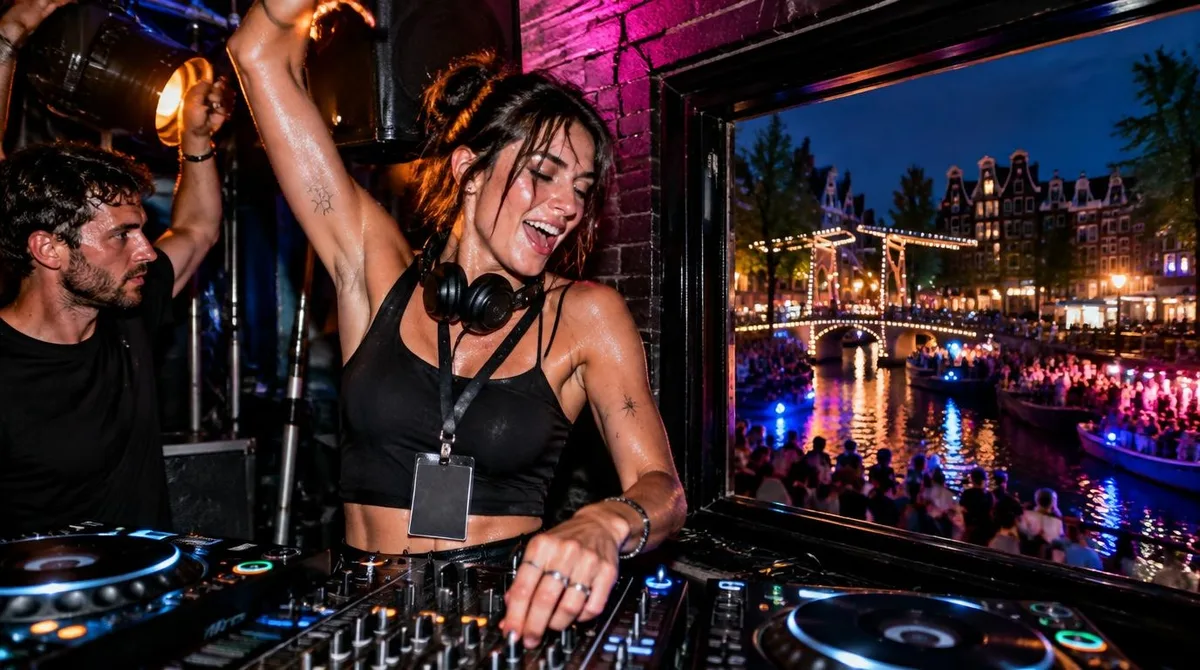
The Amsterdam Dance Event is a five-day October takeover of one city by one industry. Daytime belongs to the conference, where labels and booking desks trade in panels and handshakes. Night belongs to a festival wired through the city's clubs. Organizers count more than 1,300 events across 300-plus locations. They also record 600,000 visitors for 2025, their best figure yet.
Scale arrived fast. The encyclopedia record dates the start to 1996. That first conference ran three days for 300 delegates, with thirty DJs playing across Paradiso, Melkweg and Club Escape. The Amsterdam Dance Event Foundation, a not-for-profit group, now calls it the biggest electronic music gathering worldwide, per its own site.
How Did a 300-Delegate Meeting Become a Citywide Economy?
Growth came from the two-sided design. One pass covers the daytime program of panels and deal sessions. The festival side sells separately, through the venues themselves. That split lets a delegate conference and a public party share one calendar without sharing a budget.
The venues carry their own weight. Per the encyclopedia entry, the program spreads more than 1,000 events and 2,500 artists across 200 clubs and venues. Each room sells its own tickets. The Foundation does not program those nights, per the organizer. It invites outside events to join the framework instead.
Who Actually Buys a Pro Pass?
The buyer profile splits in two, per the organizer. ADE Pro serves working professionals. ADE Lab targets upcoming artists and young staff breaking in. Organizers counted 11,000 music professionals in the city for 2025. For booking agencies and label teams, one October week compresses a year of corridor meetings. For related coverage, see ADE 2025 Numbers: 600,000 Visitors for the 30th Edition.
The daytime schedule does more than talk. Sub-conferences cover technology and sustainability, plus startup and mentoring programs, per the organizer's site. That turns the conference floor into a hiring hall. Deals get sketched in panel rows and finished in club queues.
Where Does the Festival Side Fit In?
Music is the product demo. The most visible night is the Amsterdam Music Festival at the Johan Cruyff Arena on Saturday, per the encyclopedia entry. It is a stadium-scale show, far above the club circuit in size. Between those poles, the city runs everything from listening sessions to marathon label nights. We covered a connected angle in Why club door prices vary so much between clubs.
For the clubs, the week is a revenue spike with global attention attached. Promoters program their rooms, import guest DJs and sell to visitors who fly in for the festival. The encyclopedia entry credits the event with drawing over 500,000 people to the city. That makes Amsterdam one of the busiest clubbing markets on the calendar.
The visitors arrive primed, with lists of rooms to hit. The city runs transit late to meet them. Few markets pack this much club culture into a single week.
What Does the Conference Actually Sell?
Access is the product. A pass buys proximity. Everyone wearing a lanyard is one corridor from a decision. The decision-makers who approve remixes and the platform teams hunting catalog deals sit within a few buildings for five days. Per the organizer, the format grew from a small meeting in 1996 into the industry's biggest yearly tent-pole moment.
The pricing logic follows. Venues price their own nights, so the same week can cost a student one club ticket and cost a firm a whole delegation. Organizers even sell group discounts to companies attending with colleagues, per their site. One city, two budgets, five days.
Conclusion: A Deal Flow Engine With a Soundtrack
The Amsterdam Dance Event works because it never separates the meeting from the music. The conference fills the day with commerce. The festival fills the night with proof. The city supplies the setting that keeps both sides talking. A delegate list that started at 300 now reads like a mid-sized industry.
For anyone tracking the business side of dance music, mid-October in Amsterdam is the date that matters.