Boiler Room, launched in London in 2010 as a filmed club night streamed from a small room, became the template for how electronic music is consumed on screen: a fixed camera, a crowd pressed against the DJ, and a set that lives online forever. The format's scale is now enormous — Boiler Room's own materials count more than 9,000 artists filmed across some 300 cities, with a YouTube audience measured in millions of subscribers as of 2025.
How did Boiler Room start?
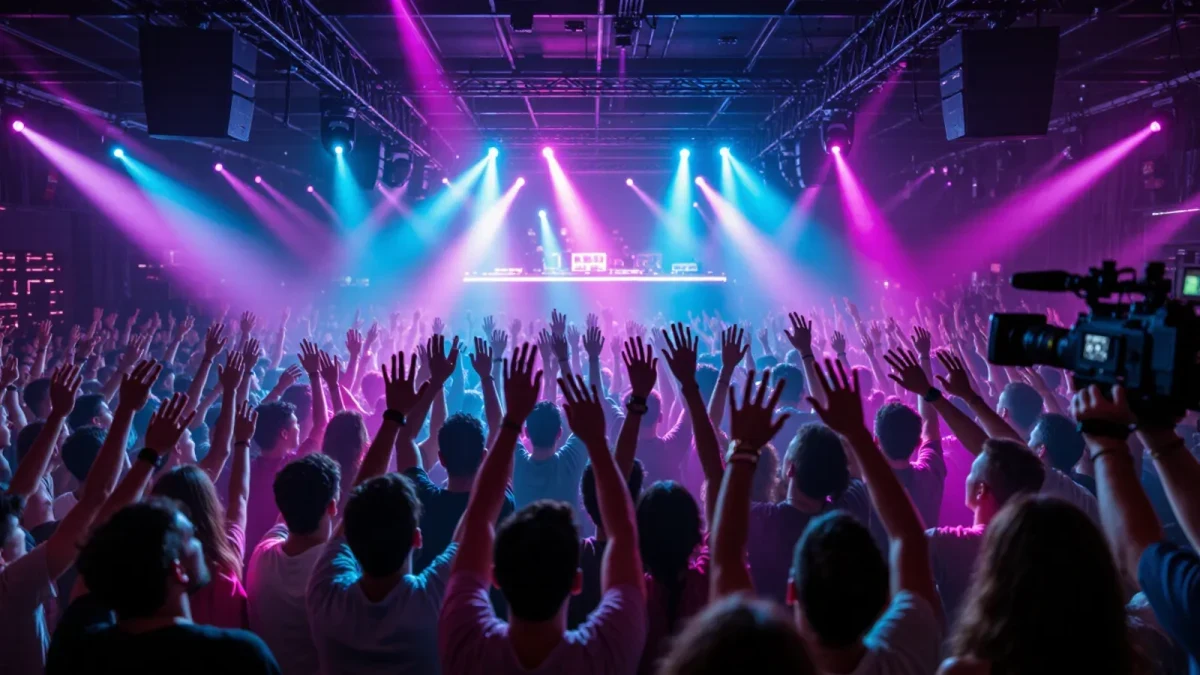
Small, shambolic and accidentally canonical. The first broadcasts in 2010 pointed a camera at DJs playing to a compact crowd in a London warehouse space, with the audience facing the DJ the way a club crowd does — backs to the camera, drinks in hand. That staging was the invention: instead of TV-style coverage of dance music, viewers got a camera inside the booth, close enough to catch a selectors' mistakes. Word spread through forum links and word of mouth; within a few years the operation was filming in cities worldwide and becoming the medium's archive of record. By its own account the platform has now hosted over 9,000 artists in more than 300 cities.
Why did the fixed-camera format work so well?
Because it sells presence rather than spectacle. The shot barely moves: DJ, decks, crowd. What changes is the music and the room's temperature — the slow build of a good set visible in the faces behind the booth. For viewers it functions as both entertainment and education; generations of new producers learned how house and techno actually get mixed by watching Boiler Room sets. The format also flatters the DJ as a personality: the raised platform puts the selector literally above the crowd, and the internet learned to read the small theatre of track selection, restraint and payoff. Viral moments — the over-celebrated mix, the phone-checking anti-moment, the surprise B2B — became the scene's shared language.
What came after the webcam era?
A whole ecosystem of live-streamed sets, each adjusting the formula. Cercle films DJs at spectacular locations — mountain ridges, historic landmarks — and built a huge audience on the contrast between serenity and bass. Streaming platforms themselves, from Twitch to YouTube channels run by festivals and clubs, normalised the archived set as a primary release format alongside records. During the pandemic shutdowns of 2020-21 the livestream became the only club in town, with lock-in marathon streams reaching audiences no venue could hold, and the habit partly stuck: the filmed set is now a standard line on a release campaign, not a novelty. Boiler Room's audience data as of 2025 — millions of subscribers and a youth-culture report it titled The New Rules — shows the appetite survived the reopening of real venues.
How do live streams pay artists?
Through three channels, none of them royalties-first. Platform payments — YouTube advertising share, Twitch subscriptions and tips — reward consistency and volume, favouring channels that stream weekly over the special event. Direct booking effect is the bigger lever: a set that travels turns into festival fees, because promoters book what they have already seen online. And brands underwrite much of the format — beverage and fashion sponsors fund production in exchange for placement, which is why so many stream series carry a sponsor's name. Recorded-music royalties barely figure: a DJ set of other people's tracks generates performance royalties through collection societies where setlists are reported, but that stream — of money — is thin relative to the stream — of video.
What did the stream era change for clubs?
It changed the audition, not the room. A DJ's filmed sets now function as a public CV: promoters weigh a four-year archive of performances, and one viral set can compress a decade of career-building into a season. It also globalised local scenes — a Johannesburg or São Paulo night can reach the world the morning after — while feeding a recurring anxiety that the best-paying gig is the one where people face away from the dancefloor and toward the lens. Venues adapted with in-house cameras and archive channels of their own. The camera in the booth is now as standard as the booth.
How should a DJ prepare for a filmed set?
The honest answer: prepare for the crowd in the room, not the camera, because the camera rewards exactly that. The sets that travel online are the ones where the DJ reads the small room and builds a real arc — the crowd pressed behind the decks is the visual instrument, and a set that ignores it films as badly as it lands. Technical preparation is narrower than a club gig: confirm the gear, bring backups of everything on two USB sticks, and plan an opening strong enough to land in the first five minutes, because that is the clip window the internet will judge.
The professional details matter more than producers expect. Tracklist reporting — submitting what you played so rights holders get paid — is both an obligation and a courtesy the scene owes itself. And the aftermath is part of the booking: a set that clips well becomes a pitch asset for years, so DJs treat the track selection as a portfolio decision, not just a night out. None of this argues for caution. The format's whole appeal is a real DJ taking real risks in a small room; the preparation just makes sure the risks are the interesting kind.
What has the stream era cost?
Two honest losses. The first is scarcity's old magic: when every set is filmed, a performance's afterlife is no longer an event, and clips compete in a feed that flattens the difference between a warehouse at four in the morning and a phone screen at noon. The second is local reticence — promoters increasingly book the camera-ready over the scene-weird, because a recognisable face sells a thumbnail. The room still wins on the night. But the industry around the room now audits everything through the lens, and pretending otherwise would be less honest than the footage itself.
Boiler Room's core insight was never technological. It was that dance music's real drama is a person choosing the next record — and that a static camera, held long enough, is the best seat in the house.