Analog versus digital is the oldest argument in synthesis. The debate gets loud, but the facts are simple. The two machines build a signal in different ways. Each way leaves a mark on the sound and on how you play. Learn those marks, and you can pick the right tool for each job.
An analog synthesizer makes sound with analog circuits and analog signals, per Wikipedia (Wikipedia). A digital synth takes another road. It computes a stream of numbers and sends them to a converter. The converter turns those numbers into the voltage that becomes sound, per Wikipedia (Wikipedia). Same goal, different paths.
Inside an Analog Machine
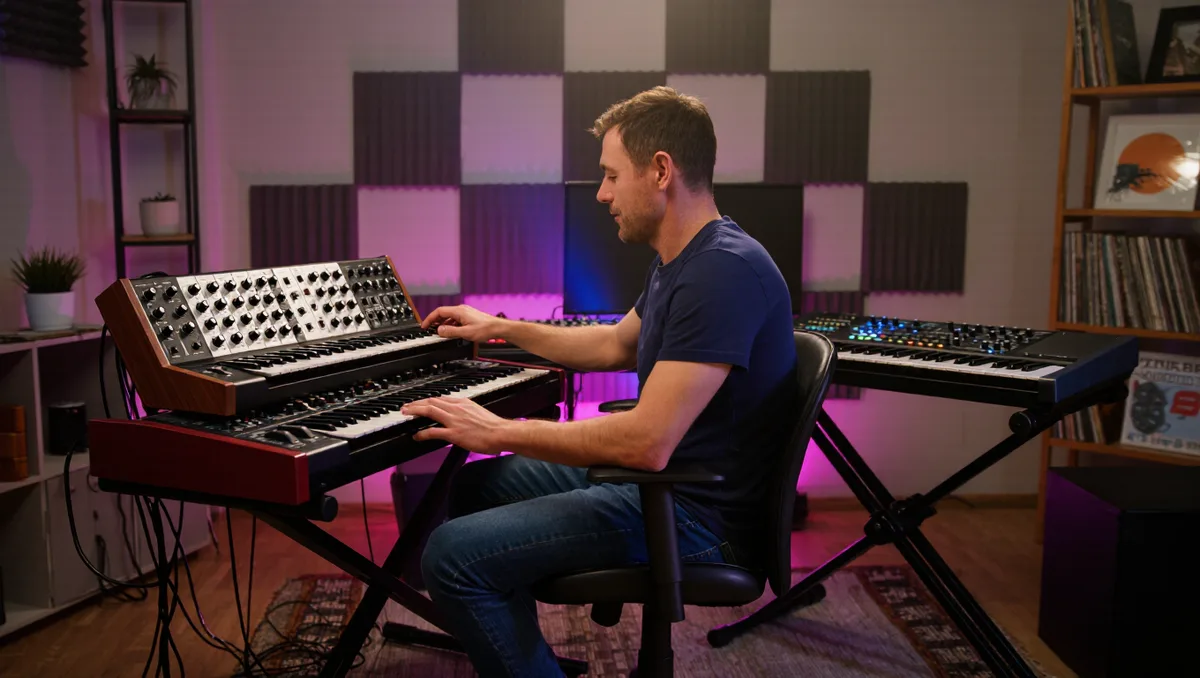
Analog synths shape a live electrical signal. The first machines, like the Trautonium, ran on vacuum tubes, per Wikipedia. Designs after the sixties used op-amp chips instead. Knobs called potentiometers set the sound. An oscillator makes the tone. A filter shapes it, and an amplifier sets its level.
That flow became the classic template: oscillator, then filter, then amplifier. Early modular rigs linked the blocks with patch cables. Cables could wear out, and big patches were hard to rebuild. Later machines wired the blocks inside one case. The Minimoog led this shift and sold more than twelve thousand units, per Wikipedia. Moog also set the control standard for the industry: one volt per octave for pitch, plus a separate trigger pulse, per Wikipedia.
The blocks also worked in reverse. Feed an outside sound in, and the machine can process it. An analog synth could create sound and reshape sound at once, per Wikipedia. That made it a studio tool, not just a keyboard.
Inside a Digital Machine
Digital synthesis starts with math. The engine computes a number for each instant of sound. Often it reads stored waveforms from memory. A converter turns those values into signal at the end. Any wave shape can be stored, per Wikipedia. So a digital wave is not stuck with the simple shapes of a basic analog oscillator.
Storage also changes the workflow. Waves can glide from one to the next with interpolation. An LFO or envelope can steer the motion. Some engines even imitate analog effects like pulse-width modulation, per Wikipedia. Whole patches can be saved and recalled with no drift.
So What Sounds Different?
Here is the honest part. The sources explain how each type makes sound. They do not pick a winner, and neither will we. Analog gives you a live voltage path and a knob for each move, per Wikipedia. Digital gives you any wave shape, smooth motion, and perfect recall.
History added limits of its own. Analog circuits made single notes hard to build, so most early synths played one note at a time, per Wikipedia. Polyphonic analog designs offered about four voices. Digital engines faced no such ceiling. That is one reason presets and big chords became normal.
Which One Fits Your Setup?
Pick the workflow you will actually finish songs with. Software runs on the computer you own, saves everything, and costs little. Hardware pulls you away from the screen and into the patch. Many producers use both: a digital core, plus one analog voice for color. Try each if you can, because hands pick faster than specs do. The best synth is the one that finishes the track. This connects to our earlier piece, Apple Music Grabs Head Trip, But What Does the Livestream Race Actually Buy Dance Fans?.
Conclusion: Two Roads to One Signal
Analog machines shape a live voltage with an oscillator, a filter, and an amplifier. Digital machines compute numbers and convert them at the last step. One gives you hands-on control with old limits on voices. The other gives you stored waves, motion, and perfect memory. Neither wins by default. Your ears pick the right tool per track. Readers following this should also see Eight Delhi Artists, One List: What Beatportal's Roundup Gets Right — and Skips.