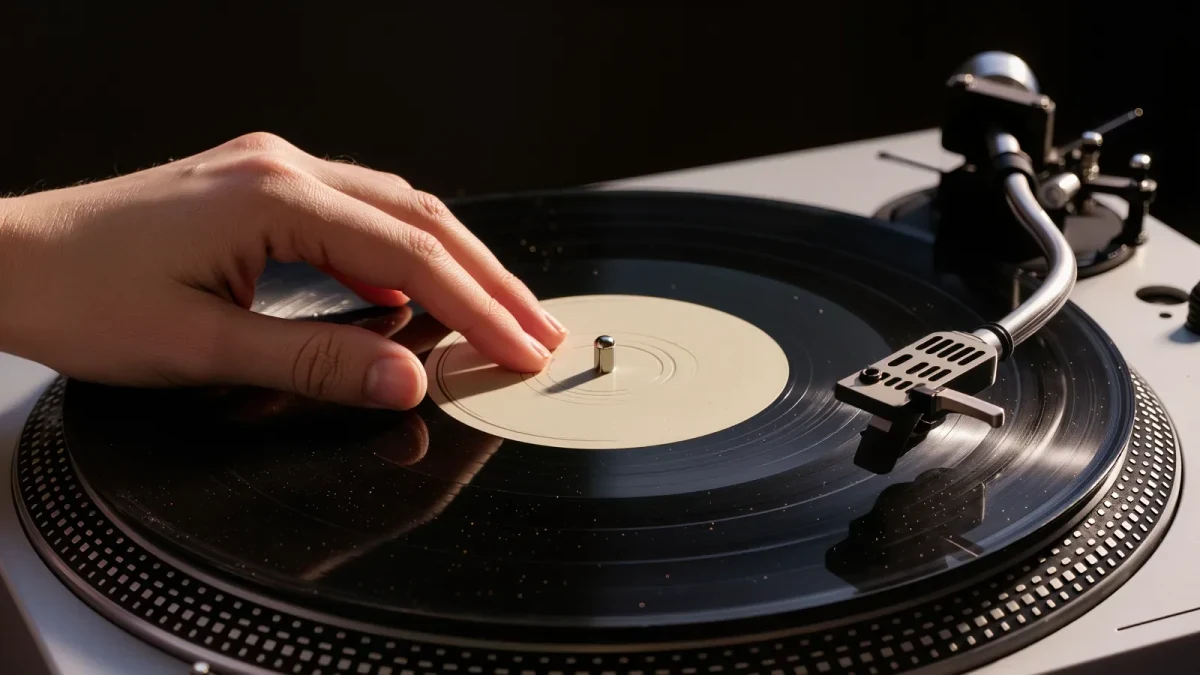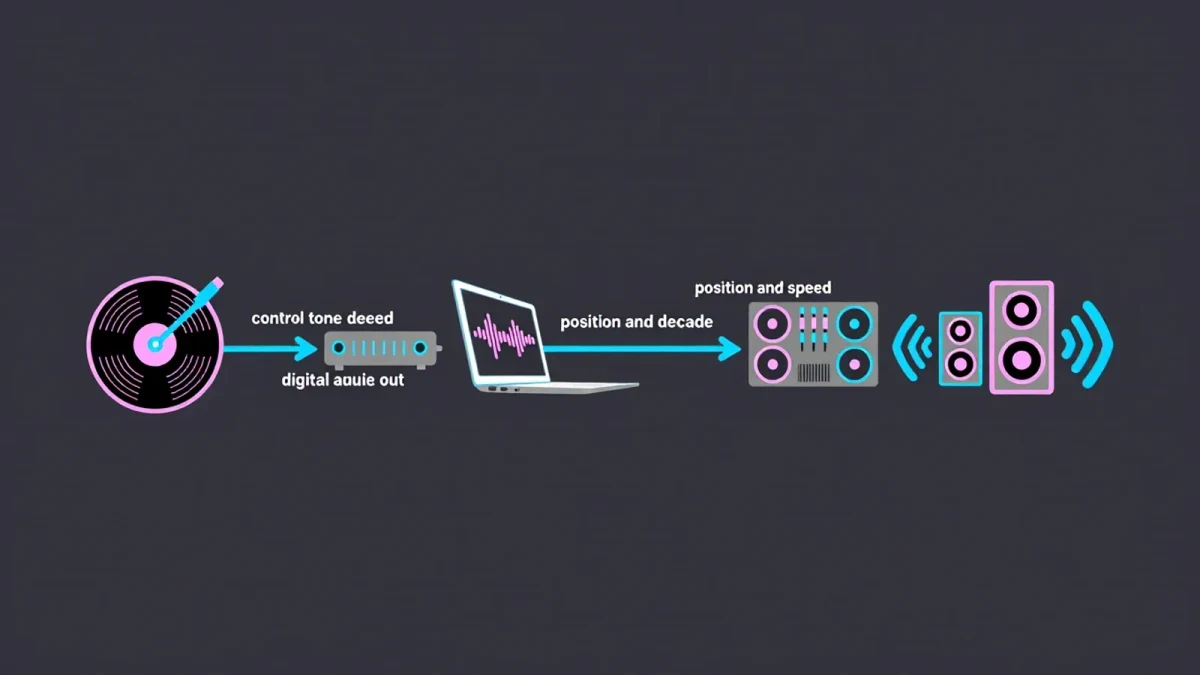
A digital vinyl system (DVS) is a setup where special timecode records on real turntables control digital audio files on a computer: the needle reads a control signal pressed into the vinyl, software translates that signal into position and speed, and your MP3 or WAV responds exactly as the record does. You get the hands-on feel and turntablism vocabulary of vinyl with the library, cue points and portability of digital files. Serato DJ Pro, Traktor Pro and rekordbox are the three ecosystems that dominate booths and bedrooms alike.
The technology is two decades old and battle-proven — here is what is actually happening under the needle, and why scratch DJs never gave it up.
What is timecode vinyl and what does it contain?
A timecode record carries no music. Its grooves hold a continuous control tone — a specially designed audio signal in the kilohertz range that encodes position information thousands of times per minute. Each millimetre of the groove corresponds to a known position in the signal's pattern, so when the needle reads it, the software knows exactly where on the record the stylus sits, how fast it is moving and in which direction.
Because position is encoded continuously rather than in chapters, the system tracks every physical gesture: the slow drag of a baby scratch, the whip of a chirp, a backspin that reverses playback instantly. Push the record backwards and the digital file plays backwards through the same point, sample-accurately. This is why a turntablist's entire vocabulary — cuts, drags, tears, transforms — translates to digital files without dilution.
The records themselves cost a fraction of a music pressing, wear out like any vinyl and are consumables: after enough hours the high-frequency control signal degrades and tracking gets jittery, so working DJs keep spares in the bag.
How does the signal travel from deck to software?
Chain it and it is simple. The turntable's output — the timecode tone — runs into an audio interface certified for the system: Serato's own hardware, a Native Instruments audio interface for Traktor, or a compatible mixer with DVS support built in, which many club-standard DJMs now include via a licence. The interface converts the analogue tone to digital and hands it to the software, which continuously compares the incoming signal against a reference map of the timecode.
From that comparison the software derives three numbers, many times per second: absolute position on the record, playback speed and direction. It then seeks the matching position in your digital file and plays it with identical speed and direction, output through the same interface to the mixer. The whole loop runs fast enough that the file's motion and your hand's motion are, to the ear, the same event.
One consequence of absolute-position tracking: the physical record behaves like a fixed map. Drop the needle at the start of the timecode and the file plays from its beginning; drop it in the outer grooves' relative-mode zone and you can loop, jump and cue without the needle's physical position mattering. Absolute versus relative mode is a mode switch every DVS offers, and most working DJs live in relative.
Why do DJs still choose DVS in a CDJ world?
Feel, first. A turntable's platter is a direct physical connection to the music's motion — torque, inertia, the drag of a finger — and for scratch DJs, hip-hop openers and anyone whose style was built on vinyl, jog wheels remain a translation rather than the thing itself. Turntablism's competition culture and its whole technique vocabulary assume 12-inch control surfaces.
Second, breadth. A DVS laptop library carries tens of thousands of tracks to a gig — white labels, unreleased edits, the entire digital archive — while a vinyl-only bag carries forty. For selectors whose value is depth of crate, DVS splits the difference: vinyl gestures, digital reach.
Third, hybrid workflows. Many house and techno DJs run DVS precisely to keep turntables at the centre of a setup that also includes CDJs or samplers: two 1210s on Serato, a CDJ for the unreleased USB material, all through one mixer. The club never had to choose, so neither did they.
What can go wrong, and how do you prevent it?
The classic failure list is short and known. Needle skipping — from worn styli, dusty timecode vinyl or a badly weighted tonearm — makes the software stutter or jump; the fix is fresh needles, spare control records and tonearm weight set properly. Grounding hum from an ungrounded turntable pollutes the control signal; ground the deck. Latency spikes — a buffer set too low on a struggling laptop — put audible delay between hand and speaker; raise the buffer and close everything that is not the DJ software.
USB-versus-laptop reliability remains the honest trade: a CDJ booting from a stick has fewer moving failure points than a general-purpose computer running real-time audio. DVS veterans answer with ritual — dedicated laptop, nothing installed but the gig software, licences and backup timecode records in the bag, and a USB fallback prepared for the night the laptop disagrees with the plan.
Then maintain the analogue side. Timecode records are consumables; needles are consumables; the technique of keeping both fresh is the same discipline vinyl DJs have practised for fifty years.
How do you start with DVS in 2026?
The entry paths are clearer than ever. Many mid-range and professional mixers now ship DVS-ready, needing only a software licence unlock; audio interfaces bundled with Serato or Traktor licenses start well under the price of a single CDJ; and second-hand Technics-sl turntables — the deck the entire culture standardized on — remain the default hardware purchase, with modern alternatives from other manufacturers at lower prices. Budget for the two consumables people forget: spare timecode vinyl and a fresh stylus.
Set it up at home, calibrate inside the software — most systems graph the control-signal quality so you can see a clean tone versus a worn record — and run the whole rig for a week before trusting it in public. DVS rewards preparation exactly like vinyl always did: the system is only as dependable as the hands maintaining it.