EDM stands for electronic dance music. It is not one genre. It is a broad range of percussive electronic styles originally made for nightclubs, raves, and festivals, and it is generally built for playback by DJs who stitch tracks together into a seamless mix, as Wikipedia's overview of electronic dance music puts it. The catch: the word means two different things depending on who is talking.
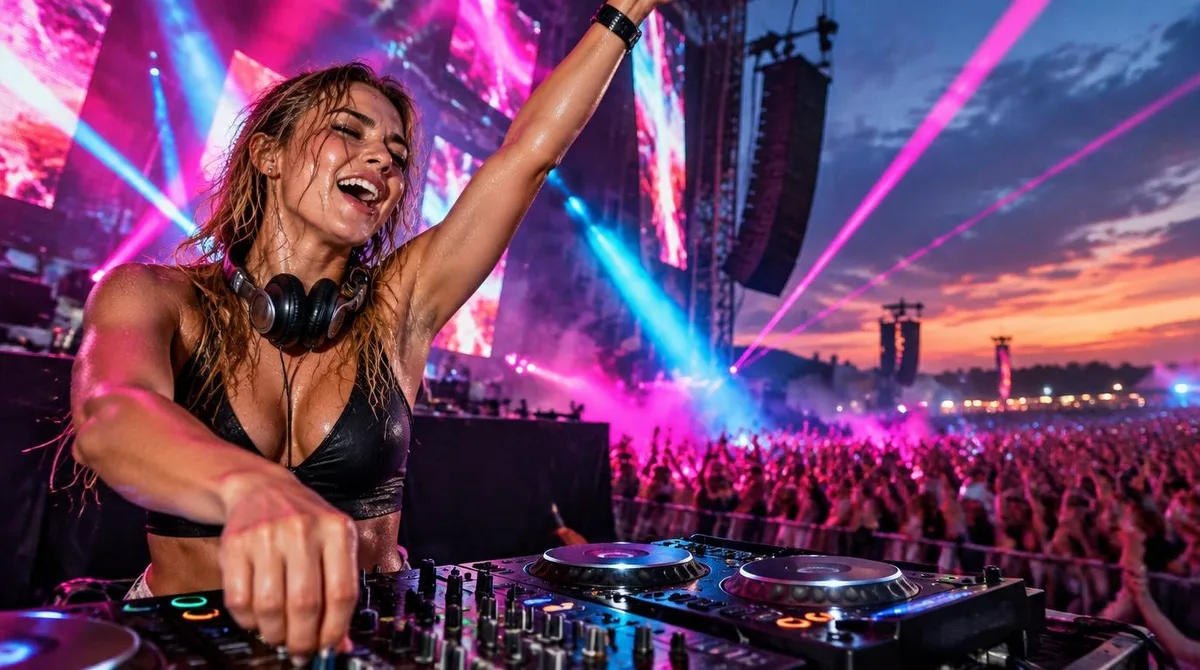
Ask a producer and EDM covers everything from house to drum and bass. Say "EDM" at a festival, though, and most people picture one thing: big synths, clean builds, anthemic drops, and a main stage the size of a small town. Both uses are correct. Knowing which one someone means is the first step to making sense of the scene.
This guide walks through where the term came from, what it covers, the sounds that define it, and the genres worth learning first. If you want the wider map of the culture, start with our DJs hub.
What does EDM actually mean?
Technically, EDM is an umbrella term. It covers all electronically produced dance music — techno, house, trance, dubstep, drum and bass, and dozens more. The genres it names predate the label itself. As EDMProd's beginner guide explains, the American music industry pushed the term in the early 2010s as a way to rebrand American rave culture for a mainstream audience.
In practice, most people use it more narrowly. Say EDM and they mean the polished, high-energy, festival-facing style that exploded globally in the early 2010s: supersaw synths, pumping sidechain compression, and a drop engineered to hit hard in a massive venue. Neither usage is wrong. Context decides.
That split matters for anyone new to the scene. A club night billed as "techno" and a "EDM festival" main stage are selling very different experiences, even under the same umbrella.
Where did EDM come from?
The roots run deeper than the name. House music came out of Chicago. Techno took shape in Detroit. Trance, drum and bass, garage, and electro grew in clubs across Europe and beyond — all before anyone called the whole thing EDM. Per Wikipedia's history of the genre, EDM reached mainstream popularity in Europe and Japan between the late 1980s and early 1990s, driven by rave culture, pirate radio, and party crews. The United States lagged: rave culture stayed regional, and mainstream media and the record industry there remained openly hostile into the 1990s.
Even earlier threads fed in. Jamaican dub producers such as King Tubby and Lee "Scratch" Perry treated the mixing desk as an instrument, foregrounding reverb and delay. Hip-hop DJs, inspired by sound system culture, turned two copies of the same record on two turntables into the breakbeat. Disco producers put drum machines on records. Each of those experiments shaped the toolkit dance music still uses.
As production software got cheaper in the 2000s, more people could make dance music at home. Then came the boom: between roughly 2010 and 2015, festival-sized EDM went global. Main stages scaled up with pyro, lasers, and crowds in the hundreds of thousands, and pop acts started calling dance producers for collaborations. The wave cooled after that, but it never disappeared — it branched out into pop crossovers, heavier sounds, and a return of techno and tech house to the spotlight.
What defines the EDM sound?
Mainstream EDM has a few recognizable fingerprints. Production is polished and loud, built for impact: supersaw synth stacks, saturated leads, tight snares, and sidechain compression that makes the mix pump against the kick. It is engineered for big systems and big spaces.
Structure matters too. Instead of a verse-chorus shape, most EDM tracks follow a build-and-drop arc: intro, build, drop, breakdown, build, drop, outro. Tension rises, the drums cut, a riser screams in, and the drop lands. That format dominates mainstage sets because it works on a crowd of thousands.
The third trait is adaptability. Genres like techno or drum and bass keep roughly the same codes year after year. EDM borrows freely — trance melodies one era, big room the next, future bass after that — while staying danceable and high-energy at the core. Think of it as the pop wing of dance music: defined less by a fixed blueprint than by what connects with the biggest audience right now.
Which EDM genres should you learn first?
The umbrella covers dozens of styles, each with its own tempo, rhythm, and emotional job. The DJ Mixtape's guide to the main EDM genres frames tempo as the practical map for mixing — genres that share a tempo band blend naturally, while big jumps take technique. A few pillars:
- House — born in Chicago in the early 1980s out of disco and drum machines. A steady four-on-the-floor kick and a groove-driven bassline. Roughly 118–124 BPM.
- Techno — Detroit, mid-1980s. Mechanical, hypnotic, built on repetition rather than melody. Roughly 125–135 BPM, with harder offshoots running faster.
- Trance — Germany and the Netherlands in the 1990s. Emotional melodies, long builds, cathartic breakdowns. Roughly 128–140 BPM.
- Drum and bass — the UK, early 1990s. Fast, breakbeat-driven rather than four-on-the-floor, running 160–175 BPM over deep rolling bass.
- Dubstep — South London, early 2000s. Signature wobble bass and a half-time feel around 140 BPM, later mutating into the drop-heavy US variant.
- Electro and progressive house — the backbone of the big-festival sound that broke mainstream in the 2010s.
Genre boundaries are exactly where new DJs get caught out — techno is not tech house, drum and bass is not dubstep. If you are building sets across styles, our guide to switching genres mid-set covers how DJs move between BPMs without losing the floor, and electronic holds the wider genre coverage. For related coverage, see Genre Switching — Switching Genres Mid-Set: How DJs Move Between BPMs Without Losing the Floor.
How does EDM relate to DJ culture?
EDM and DJing grew up together. The music was made to be mixed, and the DJ is the delivery system: segueing from one recording to the next so the floor never stops. That is why the craft skills — beatmatching, reading a room, pacing energy across a set — transfer across every genre under the umbrella.
Producers also perform their music live in concert and festival settings, sometimes called a live PA, so the line between DJ set and live show has blurred. Either way, the skills behind the booth decide whether the music lands. Our pieces on reading a crowd from the booth and how DJs build a set go deeper on the craft.
There is a business side too. Festival headliners, streaming playlists, and the club economy all shape which sounds rise. If you are curious about the money, our breakdown of how much DJs actually make lays out the fee economy. We covered a connected angle in How Much Do Djs Make: How Much Do DJs Actually Make? A Pay Breakdown.
What this means for a new listener
Our analysis: treat EDM as a doorway, not a destination. The term gets you in the room, but the genres are where the culture actually lives. Start with the pillar styles — house, techno, trance, drum and bass, dubstep — and follow the threads back. Chicago house leads to disco; Detroit techno leads to Berlin; UK garage leads to dubstep. Every trail is worth walking.
One practical step: when you hear a track you love, find out its genre and tempo. That single habit teaches you the map faster than any playlist, and it tells you which nights, which DJs, and which stages will play more of what you like. The evidence here is clear on one more point: the names change, the umbrella holds. The genres predate the label and will outlast whatever word the industry uses next.