Clubs upgrade their sound systems because sound is the only thing they sell that a home speaker cannot copy: a properly commissioned system in a treated room delivers physical bass and clarity at volumes no living room approaches, and in the streaming era it is the last irreplaceable live experience. The proof is in the spending: even through the sector's brutal years of closures, serious rooms kept buying — Funktion-One refits, d&b audiotechnik and L-Acoustics installs, immersive audio pilots — because a great system fills the room when nothing else reliably does.
MEGA DANCE publishes information, not audio-purchasing advice — every room and budget differs.
What makes a club system different from a big PA?
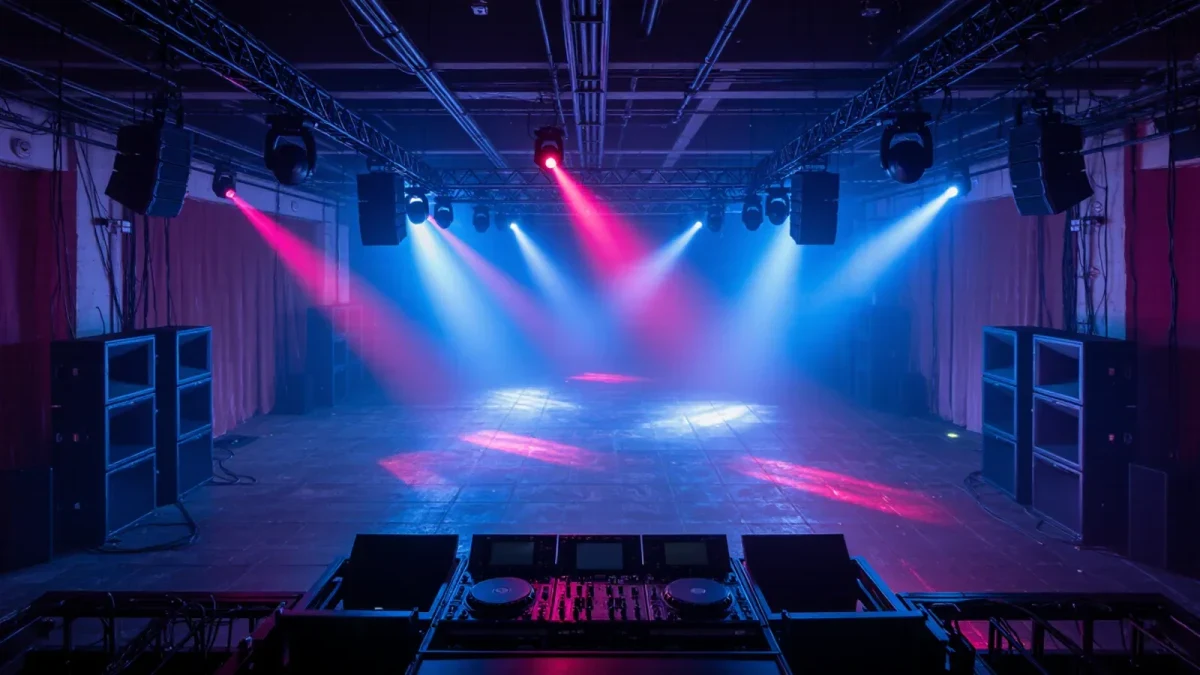
Design intent. A festival rig throws sound hundreds of meters over an open field; a club system is built for intimacy at sustained volume — even coverage across the floor, bass you feel in your chest without ear-shredding highs, and imaging that keeps the booth's mix translation honest. That takes line-array boxes or carefully angled point-source stacks, subwoofer arrays arranged to cancel bass buildup under the booth and on the dancefloor, and — the invisible half — acoustic treatment: bass traps, diffusion, isolated floating floors so the neighbors three streets away do not become a licensing problem. The electronics are the cheap part; the room is the instrument.
Why are Funktion-One and d&b audiotechnik the club default?
Track record and character. Funktion-One, the British manufacturer behind systems at clubs and festivals worldwide, built its reputation on raw, high-efficiency boxes with a distinctive aggressive-but-clear top end — the sound many techno and house rooms consider house style. d&b audiotechnik, the German rival, is the engineer's engineer: meticulous, controllable, predictable in any room, and dominant in the kind of room-and-system commissions where modeling software meets commissioning by measurement. L-Acoustics, PK Sound, Martin Audio and EAW fill out the pro tier. The brand on the stack is also marketing: serious clubbers know what a Funktion-One room promises, and venues print it on the flyer.
What is driving the current wave of upgrades?
Four forces. Competition — as ticket prices rise, audiences compare rooms, and muddy sound kills repeat business faster than any lineup. Artist riders — touring DJs specify or expect certain systems, and a club that fails the rider pays more for the same names. The immersive-audio wave — formats like L-ISA and d&b Soundscape, which place dozens of discrete speakers around a room, moved from arenas into clubs and created a new premium tier of listening experiences in electronic music. And energy rules — modern class-D amplification and system DSP deliver far more output per watt than decade-old installs, cutting electricity bills that have climbed painfully across Europe.
What is immersive audio, and does it matter on a dancefloor?
It is object-based mixing: instead of stereo left-right, the mix is placed in a three-dimensional field through arrays of speakers above, behind and beside the audience. In clubs, the honest answer is that it matters for the right event and is decoration for the wrong one. A downtempo or ambient night in an immersive room can be transporting; a peak-time techno crowd mostly needs coherent stereo and devastating low end. The technology's real impact so far is on venue identity — rooms that invested in immersive arrays host a class of audio-showcase events and command premium ticketing for them.
How much does a serious system cost a club?
Order-of-magnitude honesty: a full professional install for a mid-size room — mains, subs, amps, DSP, commissioning and acoustic treatment — runs from the low hundreds of thousands of dollars into millions for flagship rooms with immersive arrays, per typical industry project figures. Against a nightclub's margins, that is a multi-year bet financed by exactly the ticket and bottle economics that concentrate at the top of the market. It is one more reason the mega-venues keep pulling away from the mid-tier: the best sound is capital-intensive, and the rooms that can afford it charge accordingly.
What should you listen for as a clubber?
Three tells of a well-commissioned system. You can hold a conversation on the floor at full volume — if you cannot, the system is being used as a weapon, not an instrument. The bass is physical but articulate — you can hear the pitch of the kick, not just feel pressure. And the sound stays consistent as you move — no dead pockets, no ear-splitting zones by the walls. Rooms like that earn their queue; rooms with piercing highs and muddy low end are renting their reputation out night by night.
What does commissioning a system actually involve?
More engineering than most clubbers imagine. After the boxes go in, a specialist measures the room with test microphones, maps how bass collects and cancels across the floor, and tunes the system's processor — delays, EQ, level balancing per zone — so the booth mix translates the same way at the bar as it does in front of the stacks. Subwoofer arrays get physically re-aimed to fight the standing waves a rectangular room creates. Amps are gain-staged so the system has headroom it will never thermally regret. A badly commissioned premium rig can sound worse than a modest one installed with care, which is why experienced venues budget for the measurement days, not just the equipment. The commissioning report is also the venue's reference: when the room changes — new decor, a moved booth, a repaired ceiling — the system gets re-tuned against it.
How does room size and shape change the design?
Dramatically, and it is why no two serious installs look alike. A long, narrow room fights bass buildup along its length and usually wants sub arrays placed to break the room's resonant modes rather than simply stacked for maximum output. Low ceilings cap how high line-array elements can fly and push designs toward horizontal coverage instead. Odd shapes — L-rooms, pillars, mezzanines — create shadow zones that fill-in speakers must cover on their own delays, timed to the main stacks so the transitions stay coherent. Small rooms have their own trap: too much system in a tight space becomes pressure without clarity, which is why a great 200-capacity room often runs less wattage than the specs of the gear would suggest it can.
How often do clubs actually upgrade?
Full refits are rare and event-driven — a ownership change, a closure and reopening, a licensing reset or a milestone anniversary with capital behind it. What happens continuously is refresh: amplifier and processing replacement every few years as efficiency and DSP improve, driver and component servicing on a maintenance schedule, and incremental additions — extra fills, a re-tuned sub array, an immersive zone — layered onto an existing install. The rooms with the best sound reputations are usually not the ones that bought newest, but the ones that never stopped tuning. Sound quality is maintenance compounded over years, which is also why it correlates so strongly with which venues survive: the discipline that keeps a system sounding right is the same discipline that keeps a room open.
FAQs
What sound system do the best clubs use?
Funktion-One and d&b audiotechnik dominate the top club installs, with L-Acoustics, PK Sound and Martin Audio also in the pro tier. The commissioning and room treatment matter as much as the brand.
What is immersive audio in clubs?
Object-based mixing through dozens of speakers placed around and above the audience, via systems like L-ISA and d&b Soundscape, creating three-dimensional soundscapes for showcase events.
Why do club sound systems cost so much?
Because speakers are a fraction of the bill: amplification, DSP, rigging, acoustic treatment, engineering commissioning and installation for sustained club-level output push mid-size installs into six or seven figures.