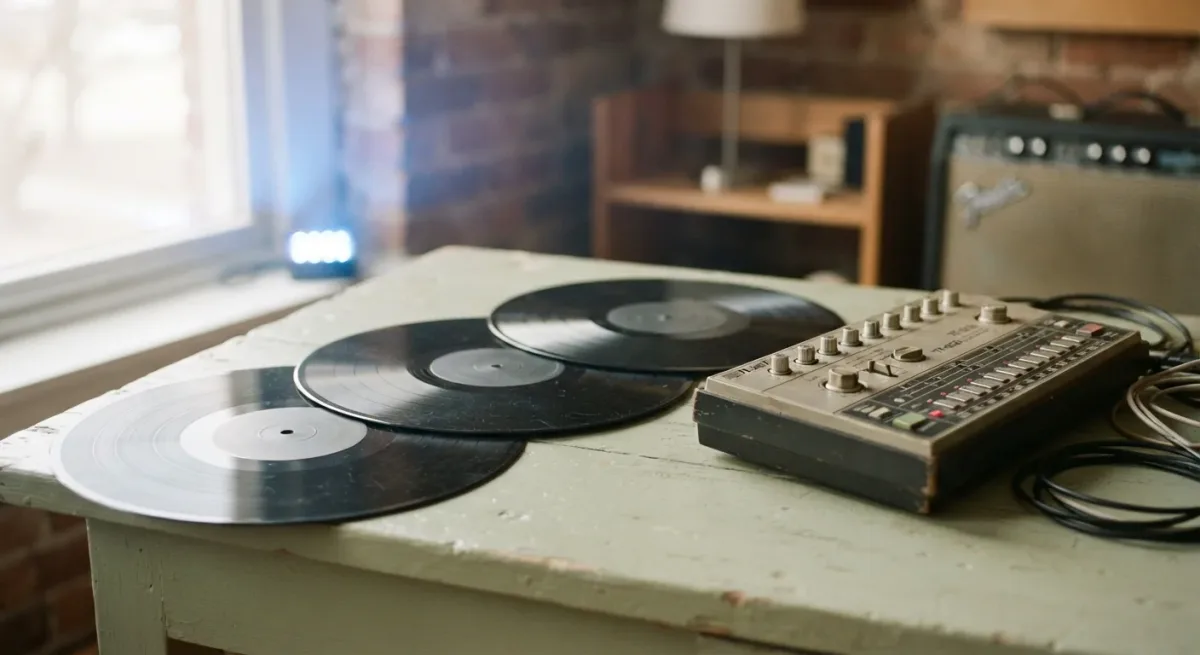
House is the Chicago-born dance music that runs around 120-130 BPM on a four-to-the-floor kick with swung, groove-forward drums; tech house is the late-90s hybrid that married house's shuffle to techno's stripped, bass-led toolkit; and techno is the Detroit-born strain that drops the swing for relentless, machine-built repetition, typically 125-150 BPM. Those three lineages cover most of a festival main-stage lineup, and telling them apart is a tempo-and-groove reading, not a matter of taste. Mega Dance runs this guide off the genres' documented histories; your ears finish the job.
The family tree matters because the words carry history: each genre names a city, a decade, and a scene's answer to the same question — what does a drum machine do all night?
Where did house actually come from?
Chicago, early 1980s, at the Warehouse — the club whose name the genre borrowed, a lineage the genre's documented histories trace through DJ Frankie Knuckles' residencies. The recipe: disco and soul records looped and extended for dancers, drum machines filling what live bands stopped providing, and by 1984-86 Chicago labels were pressing the first house records, per the labels' own release chronologies. The sound's signature is the swing: hi-hats and shuffles that push against the grid, plus piano, vocals, and warmth inherited from disco. If a track grooves and you could hum the bassline, it is house country.
What makes tech house its own thing?
The hybrid, deliberately built. Late-1990s producers — the UK and US scenes both claim founders, and both are right — took house's shuffle and dropped techno's minimal, dubby basslines and tight percussion underneath it. Tech house runs close to house tempo, usually 122-128 BPM, but the arrangement logic is techno's: fewer elements, more space, sounds chosen for the mix rather than the song. The genre's 2010s commercial surge made it the default sound of main stages and streaming playlists alike, which is why the boundary with house now argues in both directions. The test that holds: if the groove swings but nothing in the track would work as a song, you are in tech house.
What is techno, strictly?
Detroit's answer, built in the mid-1980s by the producers whose names the genre's histories carry — the Belleville three among them — fusing European electronic pop's futurism with Chicago house's dancefloor function. The signature is subtraction: no swing, no song, a kick drum metronomic and enormous, and loops that evolve by small increments over long durations. Modern techno splits by tempo and texture — the hypnotic, dubby end around 125-135, the harder industrial strains pushing past 140 into the hundreds for hardcore descendants like gabber, the Rotterdam-born hardcore strain that runs past 180 BPM. Berlin's post-2000 club infrastructure made the long-form techno night a institution; the sound itself stayed Detroit's gift.
How do you tell them apart on the floor?
Three quick checks, in order:
- Tempo first: around 120-128 with swing, house family; past 130 and flat, techno country; past 170, a hardcore descendant.
- Groove second: if the hi-hats push and the bassline could be hummed, house or tech house; if the elements stack rather than sing, techno.
- Vocals third: full songs point to house; single processed phrases point to tech house or techno; none at all settles it.
The borders are real but porous — the genre's best producers cross them nightly, and the crossing is often where the good records live.
Why do the definitions keep arguing?
Because genres are marketing categories laid over living scenes. A record sits in whichever bin sells it and sounds right in the DJ's set — tech house was literally named as a bin category before it was a scene. The lineage facts above hold from the documented histories; the arguments about the current edges are the scene arguing with itself, which is one of the sports.