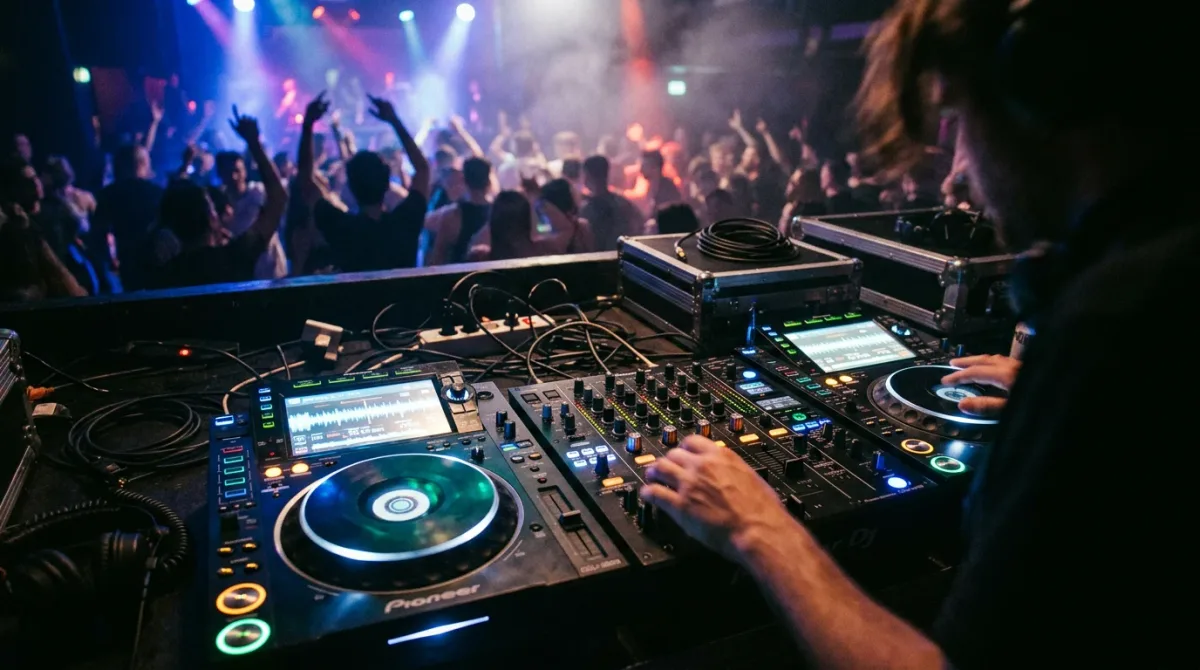
What Is a CDJ, and Why Do Club DJs Still Swear By It?
A CDJ is the digital multi-player that has anchored professional club and festival booths since the mid-1990s — today's flagship model, the CDJ-3000, plays music from USB drives, SD cards, and cloud libraries through a 9-inch touchscreen, according to its maker's current spec sheet (SRC-01). Pricing and features are current as of this writing and subject to change. Despite laptops and controllers crowding the market, the CDJ format remains the reference point DJs learn on and festivals build riders around.
What does "CDJ" actually stand for?
CDJ shortens "Compact Disc Jockey" — a nod to the format's original job of spinning CDs the way turntables spun vinyl. The line traces back to the CDJ-500, released by Pioneer roughly three decades ago; AlphaTheta (the company Pioneer DJ Corp became) marked the CDJ-500's 30th anniversary around its January 2024 product news, tying its newer gear to that lineage (SRC-03). The name stuck even as the hardware moved well past discs.
Early CDJs let DJs cue and loop digital tracks with a jog wheel that mimicked vinyl, which is why the format won over touring DJs who wanted turntable-style control without hauling record crates. That single design choice — a large, responsive jog wheel over a screen — is still the defining feel of every CDJ made since.
When did CDJs stop actually playing CDs?
Discs started disappearing from the format years before the name did. Pioneer's XDJ-1000, a USB-only deck with no disc drive at all, launched in 2014 as what a contemporary report called "the first CDJ to not play CDs," retailing at $1,199.99 and undercutting disc-drive models on price (SRC-02). That report is now over a decade old and describes a discontinued model, but it marks the moment USB sticks — not CDs — became the default way DJs carried their sets into a booth.
Modern flagship players push that further. The current CDJ-3000 reads music from USB and SD media via Pro DJ Link, pulls rekordbox-analyzed libraries through cloud sync, and can stream tracks directly from Beatport with a professional subscription — no physical media required at all (SRC-01). A DJ can now walk into a booth with nothing but a phone and a subscription and still headline a set.
What can a modern CDJ like the CDJ-3000 actually do?
The CDJ-3000's spec sheet lists a 9-inch full-colour HD touchscreen over 150% brighter than its predecessor, a lower-latency jog wheel, and 96 kHz/32-bit floating-point audio processing across every playable format (SRC-01). Up to six units can be networked over Gigabit Ethernet via Pro DJ Link, letting large festival stages share a single music library across multiple decks without swapping drives between DJs.
Connectivity extends beyond USB and SD. The player supports laptop-based software including Serato DJ Pro, TRAKTOR PRO 3, and djay PRO AI over USB-HID, plus a Lightning-adapter route for iPhone libraries (SRC-01). That range is why touring DJs can show up to almost any professional booth in the world and expect their preferred workflow to work, regardless of which laptop or app they normally use at home.
| Era | Format | Notable model | Source |
|---|---|---|---|
| 1990s launch | Compact disc | CDJ-500 | SRC-03 |
| 2014 | USB only, no disc drive | XDJ-1000 | SRC-02 |
| Current flagship | USB / SD / cloud / streaming | CDJ-3000 | SRC-01 |
Why did Pioneer DJ become AlphaTheta?
Pioneer DJ Corp now operates under the name AlphaTheta, though the two brand names are expected to coexist for a period, per the company's own product announcements (SRC-03). The rename news broke alongside two mobile-DJ products — the Omnis-Duo controller ($1,499) and the Wave-Eight wireless speaker ($899) — unveiled around the January 2024 NAMM trade show, positioning the newly named company as heir to the CDJ lineage it built (SRC-03). Club-standard CDJ hardware itself is still sold and marketed under the AlphaTheta umbrella.
How do CDJs come into play during a back-to-back set?
Back-to-back, or B2B, sets put two or more DJs on the same pair (or trio) of CDJs, trading off tracks in turns that typically run longer at the start of a set and shorten as it builds, according to guidance from the manufacturer's own DJ tips blog (SRC-04). That guide recommends DJs swap tracks with their partner beforehand to align on the set's direction, pack more music than they would for a solo set to cover unexpected turns, and reset the mixer's filters and EQs to neutral before handing off the booth (SRC-04).
Because multiple DJs are sharing the same USB drives mid-set, the same source flags a very literal hazard: pulling the wrong drive out of a CDJ mid-track kills the music, so DJs are advised to mark their USB sticks distinctly — with zip-ties or charms — before stepping into a shared booth (SRC-04). It's a small detail, but it's the kind of workflow issue that only shows up once you understand what a CDJ actually does with the media plugged into it.
Frequently Asked Questions
- What does CDJ stand for? Compact Disc Jockey — a name that has outlived the discs themselves, since current flagship models like the CDJ-3000 read USB, SD, and cloud-synced libraries rather than CDs (SRC-01, SRC-02).
- Do CDJs still play actual CDs? Some do, but the trend has moved away from disc drives since at least 2014, when Pioneer released a USB-only deck built specifically without one (SRC-02).
- Is Pioneer DJ the same company as AlphaTheta? Yes — Pioneer DJ Corp now does business as AlphaTheta, with both names in use during the transition, per the company's own announcements (SRC-03).
- How many CDJs can be linked together in one booth? Up to six CDJ-3000 units can share a library over Gigabit Ethernet via Pro DJ Link, per the manufacturer's current spec sheet (SRC-01).
Practical details
- Current flagship model: CDJ-3000
- Manufacturer: AlphaTheta (formerly Pioneer DJ Corp)
- Key specs as of 2026-08-20: 9-inch HD touchscreen, USB/SD/cloud/Beatport streaming support, Gigabit Ethernet Pro DJ Link for up to 6 linked units — subject to change; consult the manufacturer's current product page for pricing and availability.
For a related dance perspective, read How Streaming Royalties Actually Pay DJs and Producers.